INDEX
*PREMISE * *PREFACE* *AUTHOR’S INTRODUCTION* *FOREWORD BY GIOVANNI SCARANO* *CHAPTER I ** CHAPTER II ** CHAPTER III * *CHAPTER IV **CHAPTER V* * CHAPTER VI **CHAPTER VII **CHAPTER VIII **CHAPTER IX **CHAPTER X **CHAPTER XI **CHAPTER XII **CHAPTER XIII* *CHAPTER XIV**CHAPTER XV** CHAPTER XVI* *CHAPTER XVII** CHAPTER XVIII* *CHAPTER XIX** CHAPTER XX* *CHAPTER XXI** CHAPTER XXII** CHAPTER XXIII** CHAPTER XXIV* *CHAPTER XXV* *CHAPTER XXVI* *CHAPTER XXVII** CHAPTER XXVIII* *CHAPTER XXIX** CHAPTER XXX** CHAPTER XXXI*
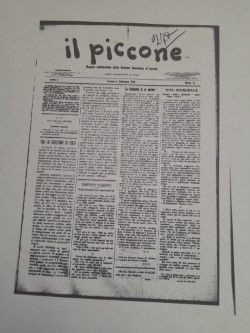
* Il Piccone*
PREMISE
The emotion and trepidation you feel when you suddenly find yourself in front of something new and unknown are a sensation that is difficult to describe; even stronger and more engaging are the pleasure and fear of the adventure you are about to experience when that something is a book, a text that tells a human story apparently far from your time and your world and that instead you discover belongs to you totally, because it deals with places, people and events that you feel so close to that you are assailed by the unpleasant sensation that, until that moment, you have lived without an important fragment of your history. It was not easy to track down Giovanni Scarano’s book, “Le confessioni d’un parroco”, because oblivion had hidden it well under a thick layer of dust. Good luck, however, with the help of many people fond of the author and his story, wanted it to be found in a fund of a small provincial library. With an extreme sense of responsibility, with deep respect for the man and his earthly adventure and with the consent of the great-grandchildren of Giovanni Scarano, we are pleased to propose the complete reprint of his text, convinced that its dissemination can represent a small contribution to the restoration of dignity and value to a man who chose to live a bitter destiny to the full and with awareness, rather than betray the Thought suggested to him by his Reason. The fortunate and unpredictable contact with some descendants of Beniamino Mastroiacovo (1845-1897), now resident in Argentina, has given us the opportunity to learn about the history and life of Giovanni Scarano, who was born in Trivento on March 30, 1872 to Luigi and Carolina Molinaro, sixth of seven children, brother of the well-known professor and essayist Nicola. His childhood was troubled by the early death of his mother and his youth, as he himself recounts, was devoid of the natural “carefree playfulness”. He completed his studies at the Diocesan Seminary of Trivento and, at a very young age, was ordained a priest. In 1900, at only 28 years of age, he was appointed parish priest of the Church of Molise, carrying out his duties with the esteem of his superiors and the appreciation of the people, divided between study and the practices of his ministry. On 14 October 1901, in the Church of Santa Maria in Valleverde of the Friars Minor in Celano AQ). He was called to give a panegyric on Saint Francis, a trace of which is preserved thanks to the publication edited by the publisher “San Bernardino” of Siena. Nothing, up to that moment, let foresee the decision that was maturing in his soul and which, like a bolt from the blue, manifested itself in 1904 with the decision to abandon the priestly habit. The years preceding this extreme choice were for Giovanni Scarano a period of great interior torment that, repeatedly, brought him to the brink of suicide. With great strength of mind and profound serenity of spirit, he fled from this temptation, aware that he was going to meet a destiny that reserved for him spiritual and material deprivation and mortification. He was in fact struck by major excommunication which, by definition, condemned the excommunicated person to be distanced and avoided by members of the Christian family as a contagious person, and physically expelled from social life because he was considered dangerous. Having fallen into poverty and with no prospect of rebuilding a civil life in his own country, he decided to emigrate to Argentina where he met a young Hispanic woman, whom he married in 1909, and with whom he had five children. He thus rebuilt his own civil and human dimension through hard work and strong devotion to his family until, in 1920, an accident that occurred while carrying out the care and management of his forestry company put an end to his tormented existence. His drama, revealed in the text proposed in reprint, cannot leave readers indifferent who, between the lines, will grasp the depth of thought of the author, his structured classical culture and a surprising interest in the evolution of contemporary thought that manifests itself, significantly, through the attention that the character places on the analysis of the works of the major interpreters of the philosophical and scientific culture of his time. It is of great interest to note how he, in 1904, thirteen years before the October Revolution, despite sensing unmistakable signs of the affirmation of Marxist ideology in the society of his time, crushes its value as a resolving thought of the precariousness of social organization, stating that “it is in reality a violent reaction that prepares reprisals and revenge, because instead of dampening passions it excites and fuels them; instead of educating it wants to transform; instead of equalizing it tends to claim; thus continuing that disastrous swing of those who rise and those who fall, to the detriment of all
Luigi Fagnani– Alessandro Vasile
Only a few and fragmentary pieces of information have come down to us about Giovanni Scarano’s life in Argentina. Thanks above all to his great-grandchildren and in particular to Romulo Alejundro Scarano and his wife Maria Rosa Barbaran, it was possible to learn about a few other, but significant moments of his life. Below, the memory he traces of his great-grandfather Romulo Alejandro Scarano. The Argentine Republic was preparing to celebrate its one hundred years of independence when the ship entered the Rio de la Plata, carrying Giovanni Scarano to American soil. Once he arrived in Buenos Aires, walking along the sidewalk where Tango was born, tinged with nostalgia for the homeland of Garibaldi and the voice of Enrico Caruso, Giovanni met a teenager from Santiago named Pastora Ibàfiez, with a dark face and a strong and bold character, whose gaze struck his heart. Soon after, having married this young woman, Giovanni, continuing his journey in the heart of Argentina, reached a remote region located in the northern plain, whose landscape is dominated by immense forests of giant trees. West of the city of Santiago del Estero, in the small town where his young wife was from, called “Choya”, an almost hidden place, which in those years, thanks to the construction of the railway, was going through a moment of particular economic and cultural fervor, they established their residence. Giovanni began to start a large forestry business from which he drew the means to support his large family of five children. They were happy and economically secure years. But nostalgia for Italy began to bite at his heart and, hoping to overcome his wife’s resistance, he began to prepare to liquidate his businesses and return to his parents’ land. It was precisely at that time that he was the victim of a strange accident with the horse-drawn carriage, which he usually used to supervise the work in his company. He died after a couple of days of agony leaving a young widow and five children. An administrator with a bad and overbearing character, taking advantage of the situation, expropriated the family of all their assets, reducing them to the most touching poverty from which also arose the isolation from their parental roots. The portrait of Giovanni Scarano in America belongs more to the realm of legend than to the objective, cold and historical story. His great-grandchildren have never seen his photos on the walls of the house and have never even found, hidden in old trunks and attics, his images and memories. The little they have learned about their Italian great-grandfather has been extracted from the memory of family conversations in which, occasionally, they could hear episodes and anecdotes. The location of all the stories has always been the village of “Choya”, a place – now a ghost – that is located west of the city of Santiago del Estero and that, in those years (1920), was the cultural and social refuge of a pretentious aristocracy. Among the most memorable stories for all then children, the one we remember most clearly is at the end of his book “The confessions of a parish priest”, which the widow Pastora Ibaliez, in a moment of desperate madness, burned along with many other memories. This episode was always told in a low voice so that the children would not hear and for this reason, it has imprinted itself in our memory with the indelible imprint of the forbidden story. Thanks to the research conducted, today we can know the writings of great-grandfather Giovanni. Before receiving the copy of his book, we thought that it did not exist or that it was a magazine and nothing more. Only the older aunts spoke of the existence of this book. The family tradition was to keep the names of the children, all of unmistakably Italian roots: Aida, Romulo, Nelida, Arnaldo and Isauro. It is not known why Giovanni chose Romulo as the name for his first son, a name that was later used for his grandson and great-grandson.
Romulo Alejandro Scarano
PREFACE
Norberto Bobbio used to say that he did not like to distinguish between believers and non-believers, but between thinkers and non-thinkers. This aphorism immediately came to mind when reading this work, which has now exceeded a century since the first and so far only edition and which has a title that can be misleading. The Latin words placed under the title, which will be explained only at the end as an “amended” quotation of a Psalm, already make clear the tone that will run through the entire book and that the Author, honestly, will immediately confess in the preface: “Even without any faith, I accepted existence as a natural necessity, moved, more than anything else, by a sincere and profound feeling of altruism”. The complication, for a sensitive soul tried by family bereavements, occurs because of a choice in contrast with his lack of faith: “Dominated by such a feeling (of altruism), I had the weakness and the recklessness to caress the idea of entering society with the guise of a Christian priest…not having then the courage to go back, I made every possible effort to deceive myself, clinging to my dominant thought (sic!): to be everything for others and nothing for myself”. I wanted to quote extensively words that everyone can read in the book itself, to give flesh to my reflection on the book of an author who was contemptuously called “defrocked” and being myself, instead, a Catholic priest. When Giovanni Scarano wrote The Confessions of a Parish Priest he was still the archpriest of the small town of Molise, in the diocese of Trivento but, shortly thereafter, precisely for this book so bitter and contemptuously ironic against the foundations of Christianity, he would be struck by the major excommunication and then leave for Latin America where he would make a new life with his wife and children, broken by an accident that many, in his ancient land, would have read as the sign of divine punishment. Despite the title, it is not a book in the style of Diary of a Country Priest of Bemanos, where a deep crisis of faith of a French parish priest is admirably described, resolved on his deathbed, because our man simply did not have faith. Nor can this book be placed, despite the time in which it was written (1904) in the context of the modernist crisis that the Catholic Church was going through at that time, because Scarano has no intention of proposing a reform of Catholicism or an updating of its theological language on the basis of a critical and rationalistic approach to the sacred texts, but simply its abolition, like every form of religion, seen by him as a disease of humanity, and which must be eradicated like physical illnesses, thanks to human ingenuity. He does not contrast the manuals of scholastic theology with the reflections of Protestant or, indeed, modernist theologians, but he contrasts Thomas with Darwin, creation with evolution, matter (the only reality, for him) with spirit (projection, according to him, of human lucubrations). Why then have I agreed to spend a few words on a book that is certainly not tender towards those realities that I represent with my role as a priest? In light of the initial aphorism, two reasons drove me: the first is linked to the empathy felt for the drama experienced internally by a man; the fact that at a certain point in life he felt the need to finally be himself, makes him a person esteemed by those who do not tolerate hypocrisy and respectability. His condition as an upright Catholic priest (well represented by another text published in his name just three years earlier, that is, a panegyric for the feast of St. Francis, where a pompous language of great deference towards the church and the papacy abounds) that hid the soul of a convinced atheist, tore him apart to such an extent as to almost lead him to suicide. These confessions could be seen, then, as a form of therapeutic liberation, in the wake of that psychoanalysis that Scarano does not know, but which in those very years lays the foundations in Freud’s work. The second reason is given by a question that crossed my mind while I was already reading the preface of the book: how come such a sensitive person, entering the ranks of the church, did not find people who could question him, who made him question the noblest part of the Christian message, not so much with words, since Scarano already knew them, but rather with example? He says textually: “in the life of my companions in ministry, equals and superiors, I have seen selfishness and hypocrisy, always in the company of two, three or all of the deadly sins, with rare exceptions”. And, in chapter XXIX he says bitterly: “Christ preached equality, but his successors have felt the need to establish a hierarchy that goes from the Pontiff of Rome to the last henchman, embracing the long.
Don Michele Tartaglia
A tutti quelli che hanno sofferto e che soffrono dedico questo libro, perchè ad essi ho pensato scrivendolo, in augurio di un più lieto domani To all those who have suffered and who suffer I dedicate this book, because I thought of them while writing it, in wish for a happier tomorrow Return to index To Friends and Acquaintances. My Dearest, Between the thoughts that are the subject of these Confessions of mine and the duties of my parish ministry, which I have never failed in any way, life had become unbearable to me; and in the silence of sleepless nights I never once thought of ending it all with the usual quick fix of a good bullet in the body. But I was not, as I am not, mad, or stupid, or cowardly, and therefore I have never been able to justify suicide to myself, and therefore I am still alive and healthy. The logical, necessary solution to the crisis I was going through imposed itself on me, and I accepted it unconditionally. I closed shop, because the merchandise humiliated me before myself, since I was aware of selling counterfeit merchandise. This is the only and true reason for my actions. The evil-minded will want and know how to find some other, but I want to tell you, and you must believe me, that if my convictions were not absolute, and a doubt had remained in me about the truth, nothing would have made me abandon my post. I have no wealth, nor do I desire it. I have two arms to work with and they are enough for me. The bread I sweat will be sweeter to me and my sleep will be more peaceful. When every other joy is denied me by the grim social conventionalism, I will have that which comes from the consciousness of having nothing to reproach myself for, and from the harmony of my thoughts and feelings with my works. Up to now I have cursed life, tormenting it inhumanly; and if it is no longer dear to me, reborn to work and love, it will certainly not be any more unpleasant to me, because it is more in keeping with nature. If you accept it, here is my hand as usual, and I am today, as yesterday, your
GIOVANNI SCARANO
PREFACE
Of my childhood I have only the sad memory of a misfortune, the death of my mother. My adolescence was spent between forced study and a precocious pessimism. Of youth I did not have the easy enthusiasms, the carefree cheerfulness, the dear joys that cheer and make beautiful the spring of life. At twenty-two I had meditated a lot, experimented a lot and suffered a lot. Several times I rejected the temptation of suicide, which I have always considered and consider a cowardly or senseless act, and, even without any faith, I accepted existence as a natural necessity, moved, more than anything else, by a sincere and profound feeling of altruism. Dominated by such a feeling, I had the weakness and the recklessness to caress the idea of entering society in the guise of a Christian priest, without trying to know if I had really wanted it. I felt as if I were caught in a cog, closed my eyes and let myself drift. The die was cast, and when conscience awakened in me, when I was given to measure the condition made of my life, I was not very happy. But hindsight is always 20/20; and not having the courage to go back at the time, I made every effort possible to deceive myself, clinging to my dominant thought: to be all for others and nothing for myself. But between the sacred studies that clashed with my reason; between the disgust and repugnance I felt for the daily experience of hypocrisy practiced, taught and imposed, and for the opportunity that was sometimes offered to me to see clearly to the bottom of things, facts and people; and between the tumult of my senses, which I tried in vain to calm with the inexorable logic of a generous purpose, I felt more disoriented every day. One does not deny oneself and trample on nature with impunity. Such violence causes continuous torment, when one is aware of one’s own dignity, abhors lies and is rigidly attached to duty. And I, unfortunately, know it from experience, I who, in order not to give anyone the right to cut my clothes off with reason, have suffered and suffer the martyrdom of Tantalus. But the fact is that I was one of the black gangs under the orders, not of Giovanni de’ Medici, but of His Holiness the infallible Pontiff of Rome, and it was necessary to adapt to a life that put me in constant conflict with my brain and my heart, a life that became more and more unbearable to me, both because of the constant study of having to appear and because of the violence that I had to use on myself in order not to show myself, as I would have liked, without tinsel and without make-up. However, at first, with all the good will possible, I tried to attach myself to the mission of the Christian priest, who, given the social conditions as they stood, if he has the conscience and the faith of his mission, can in a certain sense be useful. But faced with the slow suicide of his own being, faced with the secret torments that wreak havoc on those who accept such a mission without the suggestion of faith in the supernatural and carry it out in all the grandeur of an inhuman abnegation, I felt myself increasingly oppressed under the weight of an inexorable and exorbitant yoke. To seek a diversion, I turned more seriously to the study of the sacred sciences; but on every side I saw transformed myths, inconceivable absurdities, even a lack of common sense in the demonstrations of imaginary truths; and I persuaded myself that such a study would make me deny my faith, if I had ever had it. And yet I have sought this faith with all the good will possible: but in the books, which are said to be inspired by God, I have found nothing that crossed the natural boundaries, or that could not be explained naturally; in the sea magnum of Christian apologies and polemics, of the great volumes of theological and philosophical science, I have been able to see nothing but the defense to the bitter end of a principle absolutely inaccessible to reason, and therefore inconceivable and absurd; in popular enthusiasms I have had to recognize the effects of ignorance, superstition and terror; in the lives of my fellow ministers, equal and superior, I have observed selfishness and hypocrisy, always in the company of two, three or all of the capital sins, with rare exceptions. In spite of everything, since I have been a parish priest, I can walk among my people with my head held high and serene. I have nothing to reproach myself for. I have inhumanly repressed the movements of the flesh, I have silenced my reason in the face of the rigidity of duty, I have tried to lie and deceive as little as possible, but I have taught more by example than by words. I have formed the conviction that one can be a priest and work for the good of the people even while being a little more of a man. And if many disciplinary laws of the Church are not modified or abolished, according to what the law of nature and the new condition created for society by a broader and deeper thought and more in keeping with the reality of existence require, this institution, already so degenerate, is destined to disappear soon; while pruned and governed with more sincerity and common sense, it could still offer some comfort, even if illusory, to the many, many sorrows of the plebs, until education has set social destinies on the path of truth, banishing the need for religion from the world. After several years of an existence based on privations of every kind, to which must be added the continuous torment of measuring every act and every word, the need to sometimes indulge popular fanaticism, and knowing oneself to be the target of the control of malevolent, envious, gossipy and petty people, skeptical even in the face of a rectitude that leaves no connections, always ready to denigrate, to inflate the slightest and most innocent deviation, if it can even be called such; after several years of an existence based on so many different and violent sensations, which have extremely weakened my nervous system, I, considering the past and the present, and looking to the future, have asked myself: – will I be able to last until the end? I lack faith in the supernatural, and therefore I now consider every sacrifice imposed on me by my state to be vain. And yet the best years of my life have passed amidst sufferings of every kind, concealed and therefore all the more tormenting; between the life that invited me with its dearest joys and the law of a duty repugnant to nature, between solitude and abandonment. I feel humiliated before myself because I consume the product of other people’s work without producing anything for others; I am ashamed to act the histrionics any longer, while I would like to banish from the altar the truth as I feel and believe it; my blood runs cold in my veins when I hear myself called blessed, or the imprecating blasphemy of an exploited helpless struggling with need reaches me, or I catch a glimpse of the scornful glance of someone who, rightly, judges me by my clothes. How many times with a deep sense of revolt have I refused a wage offered to me by a hand calloused by work or skeletal from privation; but how many times have I had to close my eyes and accept with repugnance, forced by the imperious demands of life! How many times have I had to turn away from the incendiary light of an eye, which stared at me with desire and compassion at the same time; how many times have I faced with an air of contempt two burning eyes, while my heart was bursting in my chest; how many times have I felt the overbearing need to seek out a shining eye that, meeting mine, has immediately lowered itself dark and perilously, then escaping me with an air of pain, and leaving in the depths of my heart an unspeakable bitterness! How many long hours passed in boredom and sadness, without the comfort of a friendly word; how many dark days in which even the feast of dinner becomes unpleasant; how many white nights, peopled with images desired with all the strength of a nature exuberant with youth, and passed between anxious insomnia, the tortures of a hungry and unsatisfied flesh, the dark anger at solitude, at the desolate void in which I tossed helplessly! The hour that is approaching does not differ at all from the past, and thinking that the future reserves for me doubled pain, more intense martyrdom, to the question posed to me I answer: – No, it is time to end it; because, together with all the burden of pain that weighs on my heart, I would carry with me the terrible remorse of having unknown life, trampling on its supreme goods with ferocious cruelty, the remorse of having violated nature, of having denied it, making myself a monstrous abortion, as Mantegazza rightly says, an unworthy being, a lie and therefore a living shame. I will therefore begin life again without illusions and without ambitions of any kind, scornful of the Pharisees, who will cry scandal, confident in my strength and in my rights as a man, ready to face serenely and with the utmost indifference the unconscious judgment of the masses, prepared for the new struggles of existence without fear and without weakness, content to enjoy my share of the goods that nature lavishes on her children, happy and proud to return with full consciousness to the orbit of living matter, reuniting the fate of my individual life with that of all humanity with work and love, calvaries.
Return to index
Considering time subjectively, I can say that I have already lived a long time, because, except for a few pauses due to boredom and sleep, my sensory nerves and my brain have actively and intensely operated. My time objectified and measured, in a few more months I will count thirty-three years. At this moment of my life, which marks a point of arrival and departure at the same time, I like to manifest all the intellectual work I have accomplished; work that, determining the present stop, pushes me to lower the sails for a new route, and will be the constant norm of the days to come. The little that I have assimilated of the thoughts of others and all that is the fruit of my observation and meditation, will form the object of the pages that will follow, in which therefore the reader will find all of me, my profession of faith, my wishes for the future of the great human family, which, for the continuous renewal of the species by force of generation, is the highest manifestation of protean and eternal matter.
CHAPTER II
I have never been subjected to any external suggestion, and if at some time in my life study and events have exercised a certain influence on my mind and my heart, this has never succeeded in diverting me, in cutting the thread of my ideas, obstinately vigilant before the threshold of the great mystery of life. From the moment I had a conscience, so that I was able to ask myself the reason for what was happening in me and outside of me, passing over all the slow work of evolution and formation, I wanted to go back quickly to the origin of things and beings, I wanted to know the alpha and the omega of the universe. At first I saw everything confused and without any way out: my thoughts wandered lost in the darkness, my reason beat dejectedly either against the absurd or against the absolutely unknown. I searched in books, but I found no answer to my questions that satisfied me. Everywhere there were vain attempts, games of fantasy, oddities, deliriums, words and always words combined, strung together, piled up. From the books I walked away tired to return to myself, and, devoured by the fever of making myself fully aware of the reality of everything, I read in the great book of nature, considering and meditating on the past and the present, on things, beings and events, without prejudice, rejecting everything that detached itself and distanced itself from the nature of things, beings and events so as to leave my reason behind.
CHAPTER III
The first idea that asserted itself supreme in my mind, that I caressed with joy, because from it radiates a revealing light, a light that calms every doubt, dissipates every fog, and completely reveals the truth from which men distance themselves the more they seek it, because they persist in wanting it in their own way and not as it is in its majestic, ineluctable reality, is that of infinite space. The idea of infinite space is of a marvelous simplicity; it imposes itself on reason with an inexorable logic, shattering the idols and chimerical creations of the most fervent fantasies. Space is infinite, nor can it be conceived otherwise. Not wanting to recognize such a truth is like denying oneself, is like denying the existence of the world. We look at the sky and assign a limit to its deep abysses. I have never been able to conceive of such a limit, and I believe that no one has ever had or can have a clear idea about it. This, which is a very important point, has been neglected by all philosophers of all schools. Let us therefore assign a limit as far away as we want, and the universe will thus be enclosed in a grandiose envelope, and we will therefore have a content and a container. This container in turn will be the content of another container, and from container to container it is clear that we go to infinity. Against the hypothesis of any limit whatsoever there is the logical consequence that would come, the disturbance of the sidereal system, of which the last worlds would go to hit against an obstacle, thus lacking the universal equilibrium. To demonstrate the infinity of space there is therefore the simple fact of the existence of matter, and it seems to me that no doubt is therefore possible about such a truth. An infinite space is necessarily eternal, and from here we must take our cue to study nature in all its manifestations, from here must be born the most luminous ray that must break through the darkness of any mystery.
CHAPTER IV
The idea of an infinite space had arisen in my mind before reading a review of Herbert Spencer’s latest work: Facts and Comments (1). So the idea is not new. However, the English philosopher, although he had the intuition of such a great truth, got lost in determining the fundamental principle of his system, and by splitting it into the knowable and the unknowable, he was led to follow a false path, so that, having come to vague and uncertain conclusions, he finds himself disoriented and thinks with a certain feeling of terror of infinite and eternal space. The feeling generated by such an idea in Spencer, and from which he flees, finds its reason in the fact that after a long journey he finds himself almost at the starting point, tired, disappointed and without the energy to begin again. Nearing the end, he distances himself from the first idea that had opened up a glimpse into the great mystery of existence, and remains caught in the gears of a thought that is not his, but that has influenced him in his work and made him follow a false path: the thought of something unknown, which for centuries has weighed on the human intellect, making all its efforts vain. Now this something is either material substance or it is nothing. Spiritual substance does not exist: it is an illusion, because it is absurd to want to believe that the nature of a cause is different from the nature of the medium and the nature of the effect. Let us consider the act of thinking in us. Thought, which is the result of the molecular movements of the brain and the sensory nerves in contact with the outside, or remains of our mind or is externalized, cannot be separated from the cerebral matter that generates it and from the signs that express it. Suppress the brain and in no way can there be thought. Thought in itself does not exist. Either it exists in the brain and is not something distinct from the brain itself: or it is manifested, and is not something distinct from the organs, sounds and signs that manifest it, because it exists outside the brain to the extent that the organs, sounds and signs make it fall under our senses. Thinking is therefore a material operation, and the effect of this operation is also material, because it does not exist outside matter; in the same way that light is not something distinct from the vibrating ether. Spencer splits the fundamental principle of his philosophy, uniting under the name of knowable all the orders of phenomena, all the various forms with which the sensible presents itself to us, admitting an unknowable of which the knowable is both manifestation and revelation. This is the error that led him astray. He is rightly accused of contradiction, because if the knowable is manifestation and revelation of the unknowable, through such a manifestation and revelation the unknowable ceases to be such and is knowable. Where is the unknowable in the operation of thinking? Either one admits that thought is generated by the molecular movement of the senses and the brain, and it is clear that nothing is unknowable. But if one wants to believe that the brain is not enough to produce thought, one must admit that beyond the brain there exists something without which the brain cannot give thought. This hypothesis therefore supposes a first and initial cause which would be the unknowable something, a secondary cause or a means, the brain, and finally, as an effect, thought. And so what? Either: this something is of the same nature as the brain, and is a material principle resident in the brain itself or in the thinking subject, therefore unknowable at all, or at most of a relative unknowability; or it is of a different nature. In the first case the hypothesis falls, because given the brain as a secondary cause necessary for the effect, if the brain were eliminated there would remain a cause without order to an immediate effect, and without effect, which is repugnant; in the second case the hypothesis equally fails, because we will have a moving cause, a necessary organ of a different nature, which is even more repugnant to producing any effect. Nothing exists that is not matter, and everything that is matter is an object of knowledge, therefore everything is knowable. Spencer, having had the intuition of the truth, was dazzled and terrified by it, and, although he aimed at it, he was unable to push away from himself the something unknown by which he appears to be influenced and therefore he lacked the calm and logical rectitude to discuss it and confine it in its true terms, that is, in the matter that evolves, the only principle of the universal life of things and beings. The something unknown, the unknowable of Spencer, would like to be the force by which matter transforms itself by evolving: but this force is nothing distinct from matter; it is within matter, it is matter itself. To conceive of such a force as something distinct, outside of matter and which communicates the initial motion to matter, means to reduce the universe to the proportions (l) Rivista di scienze e lettere, Napoli, anno IV n 5.
CHAPTER V
Given the existence of an infinite space, that is, of infinite and eternal matter, I leave to the scholars of the positive sciences the study of the evolutionary processes determining the phenomena and forms of life, things and beings. I say given the existence of an infinite space, and not demonstrated, because such a truth is either intuited and axiomatic or rejected. To intuit it is for lucid and balanced minds; to reject it is for small, sick intellects, dominated by prejudices that kill reason. Therefore, profoundly convinced of the existence of infinite space, I must have the last word on the unknowable. The absolute unknowable does not exist. It may be and there certainly is an unknowable of a relative unknowability, but it is not a causal principle different and distinct from the single, infinite and eternal principle; but rather it is a phenomenon that escapes or can escape our experimental knowledge due to modifications that have occurred through evolutionary processes, or due to the lack of suitable means to give us the experience of certain processes, of certain phenomena and of certain forms, such as the passage of inorganic matter to the vital form. Here I am told: “A vain escape! If once nature under unusual causal combinations has given us the organic of the purely inorganic, that faculty is not at all lost, and by means of the most minute art, we should observe the cases in which it could repeat its effect; and since the process of the vital force in nature does not unfold except by way of generation, we should observe facts of spontaneous generation (1) “. I answer: A vain objection! We are born only once, only once these children, adolescents, young men, virile men, old men, decrepit men; only once we die. Only once in its evolution does matter reach the desired degree for an effect, and for this to be repeated, another process would be necessary; for it to be experienced, one would have to put into a furnace all the force that nature has at certain moments | i to reach certain combinations: one would have to be able to limit the infinite, and this is impossible. In natural processes one cannot go back or anticipate, and therefore one cannot ask a child for the strength of a virile man, one cannot ask a plant for fruit in spring, and a flower in autumn. On the other hand, what do we, our earth, represent in the face of the universe? A tiny place barely calculable in the infinite matter that continually unfolds and transforms itself. We are not the only ones here, in this remote zone, to manifest one of the highest and noblest forms of desired matter, life; life is not a privilege of our planet alone. At infinite distances from us, other beings palpitate and think, other worlds break up and form. If it were possible to approach a world in formation and follow and study its process for centuries and centuries, we could have the experience and knowledge of the phenomenon that is the transformation of chemical forces into vital forces, we could observe the solemn moment in which inorganic matter organizes itself to reach the highest degree of manifestation and form. For certain experiences, to produce certain effects, man has known and been able to create the means to repeat certain natural processes and to explain them. For certain other experiences, for certain other effects the means are either not yet known or are impossible to man, who, the effect of an infinite force, cannot take such a force in hand and yoke it to his experiments, his needs, his desires. Therefore, while I observe that those who demand experimental proof of certain phenomena do not know what they are talking about, and, simply because it is lacking, cry out that science has failed, persisting in rejecting real truth in order to run after fanciful causal principles, absolutely unknowable, repugnant to reason, absurd and physically impossible; I must also add that it is foolish to believe that science can become master of life and modify its conditions, can produce an infinite power and make us live forever. Life is a form of matter, and as such it is destined to pass; otherwise we would have the split of the single principle, we would have the infinite in the infinite, the eternal in the eternal, and this is simply impossible. By saying that life is a form of matter, and as such destined to pass, I mean to refer to the life of single individuals, who are precisely so many forms of living matter, and not to the single vital principle, which is matter, which is in itself eternal life. (1) The reaction against positivism”. Historia di scienze e lettere. Naples, year IV. n. 4.
CHAPTER VI
In Facts and Comments Spencer writes: « The idea of a space within which our immeasurable sidereal system vanishes at a point, is too oppressive an idea for the mind to remain in. In recent years, the consciousness that without origin or cause infinite space has always existed and must always exist, produces in me a feeling from which I flee». The de. and Chiappelli note: « Although he remains within the limits of pure thought, there is no one who does not see how thought naturally arouses a feeling here, and how from the feeling of mystery to the act of adoration it is an easy step, and that space as such is not adored » (1). Herbert Spencer, who, after having written the System of synthetic alosophy, denies it by taking a step back in the Facts and Comments, can very well end his days following in the footsteps of Littré, praising the close his eyes lulled by the disappointment of surviving under another but and retaining the knowledge of having existed (2). Unfortunately this will not be the first case. But it confirms a saying of mine about the greatest workers of thought, who have lived and died undermined by such a disappointment. If Spencer, who, having glimpsed the truth, after having long and lovingly dreamed of it, ends up denying it, because reason is made worthwhile by sentiment, logic by prejudice, the idea, daughter of his son, another idea not his own, and, falling into doubt, is forced to seek a lifeline in the unknown, is forced to deceive himself; one must not be surprised at the fact of so many others who, although raised to sublime heights in the hypo sa of knowledge, educated in the shadow, immense of the mystery, this accepted without any examination, practicing the crazy principle: credo absurdum. This for me and for all balanced people proves nothing other than the reality of human weakness and just inferiority in the face of nature. power that generates cowardice on the one hand, and the ambition to want to do something superior to reality ourselves, on the other, prevent us from clearly understanding the problem of existence, contend with the brain for the palm of absolute triumph, conspire against the knowledge of the truth that stands before us luminously, while we, seeking it under the yoke of fear and ambition, do nothing but hide and disfigure it. (1) CHIAPPARELLI – Voices of the time – Social essays (2) Did the death of the great English philosopher, which occurred at the end of ]…], prevent the weakness of Littre from being repeated? After the Facts and comments I am for yes.
CHAPTER VII
I could stop here with regard to infinite space, because I do not propose to make the exposition of a philosophical system, but only to announce my thought as it has formed in my mind, without following a determined order of induction or deduction, without any relation to the thought of others. However, I cannot ignore the way in which Christian philosophers conceive space, who maintain with their metaphysics the repugnance of an infinite space. It would take too long to show in all its extension the illogical and fantastic construction of that edifice built in the air that is called Christian philosophy. The naivety of metaphysicians lies in the fact of wanting to separate essence from being, giving subsistence to the abstract outside the concrete. Now abstraction is nothing other than the presentation of all that really exists, facts, phenomena and forms before our mind, by means of sensation. This is nothing other than the effect of the process necessary for knowledge. Wanting to consider and retain the essence of being as something distinct and different from being itself is like wanting to retain the real existence of thought outside the brain and the signs that express it, it is the same as admitting light without the ether. If this were possible we would have the power to create when, in order to know being, we make abstraction from being itself. If that which is formed in our mind, that is, the image of being, could be something existing outside the object itself and outside our brain, we would create the essence from being, and thus we would have to recognize in being a double reality of existence. Everyone sees how absurd this is because it leads to the madness of Fiethe, who claimed to have created man and wanted to create God. The blunder of metaphysics lies in admitting the existence of abstraction outside of reality, and this is the same as making the shadow exist without the body that determines it, the image without the original. If this were the case, once the shadow has been designated, it should remain after the removal of the body; in the mirror the image should remain fixed even if the mirroring subject is removed. In the meantime, having established so absurdly the separation of the entity into essence and being, into objective entity and real entity, into abstract and concrete; given certain absolute definitions of essence, of entity, of nature, of being, of form and accident, etc., it is clear that, by a twist and turn of beautifully chained words, one arrives at absurd and impossible conclusions, which give us the real existence of the abstract, now subordinating the concrete and only in reality existing. Having said this, I will note the contradiction into which Christian philosophers fall when speaking of space. “Space is conceived as a capacity, in which corporeal substances can be placed. Space is said to be full, if it is considered as occupied by bodies; it is said to be empty if it is effectively not occupied by bodies. Conclusion. There is absolutely empty space. – In fact all the corporeal substances that actually exist are finite in number, since the infinite number is repugnant. Therefore there must be certain boundaries of the corporeal world, outside of which there could be bodies that are not there; therefore empty space. Nor do we think it improbable that there could sometimes be, even between terrestrial bodies, empty space here and there. But let no beginner believe that by art one can obtain a perfect vacuum, and that such is the one that is made in the barometer. Far from empty! The space within the crystalline walls is completely full, and a clear proof of this is that objects are seen through them. Therefore light flows within them, nor can this exist without a corporeal or continuous subject. They also say that without a vacuum there could be no motion. And this would be true if the extension of every body were immutable, that is, if its extension were not subject to variation: but if a body can have a greater or lesser extension, it is clear that the space left empty by that which is contracted can really be occupied by a body which really expands, or by another which without expanding, comes to it. And this intrinsic mutability of the quantity of bodies, we believe to be an indubitable and very notable fact in nature, which, well considered, gives the key to the explanation of infinite phenomena, as we will see later. But it will take to overcome modern prejudices! In this respect we must guard ourselves from transporting to reality outside of ourselves that which is nothing other than a way, by which we, limited by space and existing in time, are forced to conceive things. He would be in great error who gave to pure space, to absolute emptiness, something real. Pure space is nothing in itself, and for this reason it is usually called imaginary. Therefore we must say that before the existence of the corporeal world, God was in himself, and if we say that He was in imaginary spaces, it is necessary that we do not place in these spaces a relation with God, because they are nothing in the order of reality. Suarez says excellently (Met., Disp. 30, sect. VII): If one wants to say that God is outside the world only by his real presence, without actual relation to anything outside himself, in this sense it cannot be denied, that God is outside the world; and this is demonstrated in conformity with the doctrines of faith and natural reason. And if one says in the same sense that God is in imaginary spaces, one speaks the truth. But those fall into error who judge that the phrase being in space implies a relation to space, as to a distinct thing and, so to speak, touched (quod contingitur), and therefore demonstrate that this is repugnant, because space is nothing. But this is not the meaning of that sentence, but we must take it in an intransitive sense (so to explain myself) and the thing is very well understood in relation to our way of conceiving: because conceiving space as a void capable of being filled by corporeal substance, we must say that the divine substance is present in it and fills it all (ibi est praesentissima divina substantia totum illud substantialiter replet).” And this is enough about space (1). The kind reader will forgive me if I had to cause him the displeasure of admiring this splendid prose, a marvelous product of a fervent mind; he will forgive me, in grace, for the pain I suffered in reading it and for the hard work sustained in transcribing it. In the meantime we want to make up for it a little by anatomizing this intellectual monster, which claims to give us a correct and adequate idea of space. Well done, well done, really excellently convoluted by those good Christians of Cornoldi and Suarez, bless their souls! I do not wish to do them the injustice of believing that they wrote to be read; rather, it is credible that they sought to pass the time, procuring for themselves the pleasure of dirtying paper to drive away the boredom of their solitude. If it were otherwise, one would have to admit in them the desire to offend common sense and to mock readers. But nothing proves that they were not, on the contrary, perfect gentlemen. Therefore space can be full and it can be empty, and there is absolutely empty space. The corporeal world must have certain boundaries, outside of which there is empty space, indeed it is not improbable that there could also be empty space between terrestrial bodies. Unless Cornoldi intends to make philosophy a conjuring trick, I have the right to know, after the so absolute assertion of the existence of the void, how these words of his should be understood: “He would be in great error who gave to pure space and to absolute void something real. Pure space is nothing in itself and for this reason it is usually called imaginary.” But if these words are to be taken as they sound and held for what they are worth, I cannot conceive of space beyond the confines of the corporeal world, I do not know how there can be an absolute void between terrestrial bodies. When certain confines are admitted to the corporeal world, one must determine their nature and demonstrate how they are proportionate to the need to obtain the separation of full space from empty space and for bodies to emerge from full space to seek a place in the void. Anyone with a little common sense can easily understand the real resistance of a pure space, of absolute void, both affirmed and denied in time by our philosopher. There is absolutely empty space, he says, even between bodies and then hastens to call it an error to want to consider pure space, the void, as something real. This is the sublimity of madness. Void is a word that expresses the idea of nothingness. Now there cannot be a void between terrestrial bodies because we would have nothingness, which is repugnant. There can be no void beyond the corporeal world, because – apart from the real existence of nothingness, apart from the necessity of a boundary proportionate to contain the universe, enclosing it as in a and therefore the necessity of an infinite container, – admitted the pure and simple where full space ceases, one must admit in the b force to impede the extension of full space, otherwise the celestial mechanics would be upset. Then nothingness would exist, it would not have a force, and since existence and force are precisely d nothingness would be a body. Cornoldi does not really say this; 61 of logic he should have arrived at it. But instead of following logic he rushes to the conclusion the words of the metaphysician Suarez, prefacing with a resounding te. And Suarez says: The divine substance fills empty space or without actual relation to space itself. But I wonder if this is serious, or is it an innocent fantasy To believe that pure space is nothing, that the void is purely or, and then to affirm that the divine substance fills such a void, and that substance is the being par excellence, infinite, present in the world &The world is the first cause of everything, is something that only madness can justify and must therefore inspire a deep feeling of insanity. Ultimately, from the way metaphysicians express themselves, it is only that so many beautiful things exist in their imagination, and I cannot give any real value to their imagination, leaving them to wander through imaginary spaces, following the marvelous divine that fills them, fleeing from the analysis made on the basis of I have one more reason to confirm the absolute real existence – or infinity, as continued infinite matter. Nor is it useful to say that the infinite in act is repugnant, because the infinite number is repugnant. We make the number, and it is clear that if there can be an infinite number, it is only an imaginary hypothesis to which metaphysicians should grant objective existence, and therefore necessarily also real existence. But to escape this logic they have the indefinite ready, and this simply means playing with words, not reasoning. The number is an operation of our mind, a way, a sign that we use for certain knowledge and experiences in the work of analysis. If analysis is precisely division, it is clear that the number is the reunion of limited parts; but this does not exclude the real existence of an infinite whole, which has the value of parts only relatively to us, relatively to the operations of our intellect, because in fact the parts do not exist, and the forms that we number are not therefore divided from the whole, from the single matter. To believe otherwise is to want to replace the imaginary with the real. After all, it seems to me that there is no need to speak of emptiness at all, nor is a definition of space necessary, because this is determined by matter, it is matter itself, without which therefore there could be no space. Space therefore is matter, and the division into full space and empty space is ridiculous and vain. (1) G. M. CORNOLDI – The Scholastic Philosophy of St. Thomas and Dante.
CHAPTER VIII
One of the facts that reveal the progressive efforts of the human intellect to know the truth is precisely religion, in which the peoples of the entire earth have always found and find the means to calm the anxious anxiety that is felt in front of the mystery, the unknown. The origin of religions is rightly placed in the fear and impotence of men in the face of phenomena superior to any human strength. To fear and impotence, however, we must add the ambition for which man, disdaining his nature common to all beings, tries to denature himself, and place himself above nature; and he has achieved such an end by conceiving and practicing the religion that from papal Rome goes back to the earthly paradise. Christianity, uniting in itself all that is best in previous religions and idealizing it to the maximum degree, marks the highest peak in the evolution of religious morbidity. I say religious morbidity, because religion in general, the daughter of an infirmity, such as fear, is in turn an infirmity worse than its mother. It is not worthwhile to give here the history of religions even as briefly as possible, recalling their series. I will only say of the Christian religion, or rather of its doctrine, just enough to take away the privation of truth that its ministers claim and to which it seems that the generations of only a part of men, professing it for twenty centuries, give it right.
CHAPTER IX
All religions, whether monotheistic or polytheistic, have a common basis: the more or less unreasonable belief in something omnipotent that holds the destinies of the universe in its hands. Christianity is founded on the truth of blind faith, by which one believes in the existence of a supernatural being, unknown and inaccessible, unproduced and necessary, the first cause of everything: God. First of all, such a being is of a completely fantastic nature, and I consider it a pure creation of the human brain, which has idealized all that is good in material nature, placing it in imaginary spaces as a prototype of perfection. Christian philosophy, considering the existence of this ideal as a possessed truth, calls it madness to want to search for it and to work around it in an inquisitive manner, because “and who can doubt that there is the Supreme Being? Who can doubt his perfection, his wisdom, his power and goodness? “There is no one in whom the light of reason has not died.” Without therefore running the risk of losing my compass, in seeking the truth of the existence of the Supreme Being, I accept it provisionally as Christian faith and philosophy teach, and I will only want to ascertain by the light of reason and common sense whether the work of the God of the Christians corresponds to his infinite perfection. I will therefore consider the Supreme Being in his manifestations ad extra, and, laying bare the contradictions into which he is made to fall, I will demonstrate his non-existence: and, debunking his supreme and infinite perfection, I will tear the mask off those who naively or hypocritically in his name, for long and long centuries, have tormented the masses, suffocating reason to impose faith; those who have cowardly speculated on ignorance, naivety, fear and weakness to lord it over and get drunk on the sweat and blood of the sons of labor; to those who, by constituting themselves a privileged caste and creating for themselves laborious idleness, have stopped the hidden path of speculative and practical thought, in order to increasingly broaden and consolidate the foundations of their parasitic and sardanapalesque life.
CHAPTER X
Given and not granted the existence of the supreme being, according to Christian doctrine this would be one and triune, and as such would have created and redeemed men. Aside from the manifest repugnance between a cause, which does not admit composition of matter and form, of substance and accidents, of genus and difference, of essence and being, and an effect such as the universe; apart from the indisputable principle, ex mihilo nihil fit; let us consider how in fact this supreme being responds to the perfection of his attributes. God created everything from nothing. Why? Christian doctrine had to determine the end of creation, and, while it says that God created freely, it admits as the principal end the glory of God. Here there is an open contradiction. Either God wanted this glory unconditionally, and, proposing it as the principal end of his work, he no longer creates freely, because everything that is principal is also necessary; or such glory was wanted sub conditione, and then it cannot be said to be the principal end of creation, but a secondary one. Furthermore, I cannot see infinite goodness in this supreme being, if he creates mainly for himself, while having need of nothing. One sees something quite different, one sees a ferocious selfishness, because, in order to achieve his intent, he creates beings who did not care at all about existing; and he creates them in such a way that if they do not respond to the end, that is, to the glory of God, they are damned to eternal pain. Here too it must be observed that either this glory is necessary to God, and then the punishment can pass, I do not know with how much justice determined; or it is not necessary, and then for an indifferent thing why so much severity, which can well be called cruelty? In both cases the perfection of God goes up in smoke. In the first because, considering the glory that men should give him necessary, he would lack something; in the second because, instead of an infinitely good and merciful God, we would have an execrable executioner and tyrant. But theologians who know a lot, to justify their prototype of perfection, admit an end, secondary to creation; let us be clear, only secondary, and this would be the happiness of creatures. Now I would realize the infinite goodness of God, if in creation he had intended primarily to make the absolute happiness of creatures; but since they want this happiness to be secondary, so be it. However, I recoil from thinking that an infinitely good being, who creates other inferior beings mainly for his glory, assigns to the latter a relative happiness, under certain given conditions and at the risk of eternal unhappiness. There is no need for any comment here. Everyone sees how this being is not at all good. Among other things, God is given the name of Father par excellence. The name of father could not be more badly appropriated and profaned. A father who, before the bed of his dying son, uses extreme remedies that can with equal probability determine the immediate death and the health of the sick man, is without doubt always a father, always gives proof of love towards his son. But a father who, having a son who lacks nothing to lead a possibly happy life, puts him in a position to lose all his possessions, risking the certain for the uncertain, must rightly consider himself unbalanced; and this is the least blame that can be made against him, because in the end it must always be admitted that he was moved solely by love for his son himself. God, as the father of men, finds himself in a much more inferior position in relation to them than the father in relation to his son in the second case mentioned. In truth, we did not exist, we were not in any danger, and if God, this our desired father, had created us solely for ourselves, to make us happy, he would have had a right to our gratitude. We would have been very happy, recognizing him as our very good father. But since he created us for his greater glory, and, while reserving for us subordinately to such an end, a certain happiness, he has placed us in the harsh condition of being able to create our eternal ruin; I have reason to believe that he is not good at all, because by putting his children in danger of being eternally unhappy, he did it for a completely selfish purpose, his glory. The children did not ask for anything, they would have more willingly been Gods in their minds, and by exposing them to risk, he cannot be justified in any way, and the name of father does not suit him even for irony. All dialectical subtlety is blunted by the fact that God created for his glory, and that such a purpose includes the possible eternal unhappiness of his creatures. Any metaphysics will never be able to sustain the infinite goodness of God, given such a fact.
CHAPTER XI
God would have created the world in six days or in six epochs, and I ask: but why, given the omnipotence of his fiat, not in a single moment, all things and all beings already existing in his thought? Why the succession? This, while leaving snares around his omnipotence, does not perhaps justify the fact of evolution? But let this also pass. After the light, the planets, the plants and the animals, God wants to do something better, he wants to fix his image in a creature that, of the creation – and the lordship, and in this work of the sixth day does not entrust itself to his word, but, having called to council the other two persons of his triune being, he shows his hands for the first time. But which hands? Those of the Father, the Son or the Holy Spirit? Truly, because the simple substance admits form, there will not have been real hands, but if there were to be, there would have been six. Even if it goes for two, the number does not count, and these are not exactly hands, but… Here, the hypothesis of hands taken for the need of the moment having been rejected, because. damn, it is clear that he could not borrow them, they must have been… ideal hands. After all, since there were hands, the important thing is that the Father deigned to dirty them in the mud to shape our body. However, it is still not enough. Hands or no hands, dirty or not, God, having shaped a thing, I do not know what to call it, would have inspired in its face a breath of life, and again, behold, man, would have been made a living soul. Nor is that enough. God himself would then have performed a high surgical operation, always with ideal hands and surgical instruments of the same kind, taking a rib from the first man and making it a woman. I do not know how convenient it is for a God of such omnipotence to resort to these small means, typical of terracotta makers, to make the most beautiful of his works: without considering that taking a rib from a man may seem like a correction, unworthy of such a great and wise craftsman. Yet it is so. Moses wrote it, and God himself is said to have inspired this marvelous story. In the meantime I cannot help but admire Moses for having been able to so minutely rewrite the story of the origin of the world, making the Jewish people believe it. What I do not know and cannot admire is the fact that so many generations have believed it in good faith up to today, and that it is still considered an indisputable truth. Jupiter falling in love with Europa, and taking the form of a bull to kidnap her, Deucalion throwing stones over his shoulder to repopulate the earth, should not be such unlikely myths. But let’s get back to the point, that is, to the first man and the first woman. It cannot be denied that God was generous and lavish with them. After having created so many beautiful things, before the creation of man, He had already prepared a place of delights, a paradise. The sacred text says: “Plantaverat autem Dominus Deus paradisum voluptatis a principia”. Here we should ask why God chose the earth as the dwelling place of man, why the paradise of delights limited to a small surface of the earth itself, when He had made the world so large, and the first man and the first woman had to multiply so much that they could not remain within the narrow confines of that delightful place? The choice of the earth is acceptable, but it is not possible to believe that, having created man and woman capable of generating and reproducing, generation and reproduction would not then have to occur. Whatever happens to this, God placed man in paradise, put him to sleep there – hypnotism is very old – took a rib from him, created the woman, presented her to the man after having awakened him, and blessed both of them, uniting them in marriage. We must believe so, because the sacred text immediately calls the woman uxor: Erat autem uterque nudus, Adam scilicet et uxor eius; et non erubescebant. Truly delightful times were those when the torment of fashion did not disfigure nature; marriage practices did not take so long and dispensations from canonical impediments were not paid! And yet a tidy sum would have had to be paid. Does it seem little? Papa Adam, master of the earth, who marries nothing more and nothing less than his rib?! Fortunately, God himself was there, who had all possible faculties, granted to him, of course, by the Holy Roman Church! I have been carried away a little by the good humor that comes to me when I recount certain pleasant stories; but we are not at the end yet. The doctrine of Christianity teaches that God enriched his creatures – Adam and Eve – with all sorts of natural, supernatural and preternatural gifts. The very seed of the latter has been lost. The former have been left to us, the latter rain down on us from heaven in an immaterial form, and these would be precisely the so-called graces, the gifts of the Holy Spirit, the infused virtues, and the like. Because of such an abundance of celestial favors our first pro This wonderful tree that gives the science of good and evil and death, reminds me of the tales of the Thousand and One Nights. What am I saying! Between the oriental tales of the Sultan’s beautiful wife and the Mosaic there is. Those are tales and this is divine revelation. However, Adam and Eve, with all their happiness, should not have been happy, if, despite the threat of death, they dared to approach fearfully and eat with pleasure the poisonous fruits. Would that God, offended by such audacity of his two firstborn sons, and seized with disdain for their disobedience and ingratitude, had expelled them from the earthly paradise, hurling upon them a terrible curse, which condemned them to a life of work and pain. That Adam and Eve were naughty children, who, in spite of paternal and sovereign prohibition, in spite of the threat of death, the tasty fruit withered, acted inadvisably, is not unknown. But that an infinitely good and merciful God should offend for such a small thing, should be moved by indignation, should transcend to terribly king his children, the work of his hands, the creature made in his image and likeness, is a fact that does not bear much witness to his perfection and his love as a divine father. Moreover, that Adam and Eve, even taking into account the harsh alternative they found themselves in, between the stimulus, that is, of the forbidden fruit, towards which they had the natural desire for a good that they lacked, the reason for which they were fully happy, and the precept of the Lord together with the danger of: that Adam and Eve therefore deserved any punishment for the sin committed, is also to be conceded. But that the guilt of the first men falls equally on all past, present and future generations, so that all men bear the mark of that fault from the city and are condemned to the same punishment, this is a fact that honors human justice, which has never made children guilty of the crimes of the fathers. Here, however, we find ourselves faced with a theological thesis of the first order, which is worth examining and discussing, because the Christian theory of original sin dishonors God, as it is contrary to the most elementary criteria of punitive justice.
CHAPTER XII
To understand my thought about original sin, it is useful to know what St. Thomas writes. The Angelic Doctor, who together with the Bible and the Holy Fathers forms the most solid foundation of Christian doctrine, affirms first of all in question CLXIII, art. I, of the Secunda s. p., that the first sin of our first fathers was pride. Indeed “ibi fuit primum peccatum hominis, ubi potuit esse primus appetitus inordinate finis. Sic autem homo erat in statu innocentiae institutus, ut nulla esset rebellio carnis ad spiritum: unde non potuit esse prima inordinatio appetitus humani ex hoc, quod appetierit aliquod sensibility good, in quod carnis concupiscientia tendit praeter ordinim rationis; relinquitur igitur, quod prima inordinatio appetitus humani fuit ex hoc quod aliquod bonum spiritual inordinate appetiit: non autem inordinate appetivisset, appetito id secundum suam mensuram ex divina regula praestitutam; unde relinquitur, quod primum peccatum hominis fuit in hoc, quod appetiit quoddam spiritual bonum supra suam mensuram, quod pertinet ad superbiam: unde manifestum est, quod primum peccatum primi hominis fuit pride”. The first sin, then, that is, original sin, lies in the disordered desire for a spiritual good that transcends the measure determined by divine law, and is therefore proper to the soul. Here I will observe first of all that, if all this were true, no fault should be inflicted upon Adam and Eve in strict justice; both because the human soul, like that which was inspired by God himself in the face of the clay molded into the form of man, would have had in itself and therefore from God, the tendency to desire inordinately, which implies imperfection in the divine work; and because, if a desire could have arisen in the soul of our first fathers, it must be held that something was lacking in their happiness. Now, since it is natural in man to desire the best, and he would certainly have received such a nature from God, why should God then blame him for it? But, I am answered, the desire was for a good that transcends the measure prescribed by divine law. Either or: either man was ordered to the possession of that good, or he was not. In the first case the prohibition would have no reason, and it would have to be considered tyrannical; in the second case, since the desire could not arise, the prohibition would have been vain. We therefore exclude this second hypothesis. The good that the first man desired must necessarily have been in keeping with his nature, because it could not be conceived how the desire for it could have been aroused in him: and therefore I say that the prohibition was unjust, and even more unjust to make a fault of the violation. But was Adam and Eve’s desire truly disordered? Given in them the rational soul and therefore ordered to knowledge, it was right and natural in them the desire to have the knowledge of good and evil: this, without prejudice to anyone, put them in a condition to better regulate their life, both in their mutual relations and in their relations towards their God and creator. In fact, however, they did not have this knowledge after eating the apple, which makes God himself appear to be a liar. If the tree had really had the virtue of giving the knowledge of good and evil, Adam and Eve should have acquired such a knowledge; as for how we also have it after so many centuries, everyone can judge. After all, one would like to blame Adam and Eve for having wanted to be similar to God, because the serpent’s eritis sicut Deus scientes bonum et malum means nothing else. This in truth could not constitute an offense or a threat against God, given his omnipotence and the impossibility of being dethroned. Certain precautionary measures and certain laws, if they can be agreed upon between beings of equal nature, are of enormous inappropriateness between beings infinitely different. Since God, an omnipotent and infinite being, has created a being infinitely inferior to himself, why deny him a good suited to the nature made for him, or, as you wish, why put him in the condition of craving a good disproportionate to nature itself? And then, is it not a duty of the Christian today to reflect the perfections of God and to render his image as faithfully as possible? Why should this have been a fault for Adam and Eve? To all this is added the improbability of the biblical story. We find a speaking serpent only in the earthly paradise. To believe that a serpent spoke to Eve, one must first consider that both the nature of similar animals and our own is greatly modified. But even if we admit the domestication of the first men with all sorts of animals, even if we find it hard to believe that Adam and Eve played with the lion, the tiger, the rattlesnake and the viper, must it not have seemed strange to Eve to hear human sounds from the mouth of a serpent, and that sort of insinuation to boot? For a creature, made by the hands of God and fabricated from the rib of a man, such naivety is too humiliating, not to say downright stupidity. But let the inappropriateness and the improbability pass; let us grant the fact as it is in the biblical text, and let us grant the sin of Adam and Eve. Even justice aside, according to the most elementary logic, fully maintaining the doctrine of Christianity on the matter, is it possible, I say, it is possible and not just, because as far as justice is concerned there can be no doubt, to lump together all the children of Adam born and unborn, lumping them together in the very guilt of the fathers and in the punishment? It is not possible, and I demonstrate this, following the reasoning of St. Thomas, who in quest. Lxxxi of the P.s.p. poses the thesis: De traductione primi peccati. The supreme dialectician begins by objecting: 1. “Videtur quod primum peccatum primi parentes non traducatur ad alias per originem: codicil enim, Ezechiel. 18.: Filius non portabit iniquitatem patris: portat autem si ab eo iniquitatem traderet; ergo nullus trahit ab aliquo parentum per originem aliquod peccatum. 2. “Accidens non traducitur per originem; nisi traducto subiecto: eo quod accidens non transit de subiecto in subiectum; sed anima rationalis, quae est subiectum culpae, non traducitur per originem, ut in I° ostensum est (q. 118, art. 2); ergo neque aliqua culpa per originem translate potest. 3. “Omne illud, quod traducitur per originem humanam causatur ex semine: sed semen non potest cause peccatum; eo quod caret rationali parte animae, quae sola potest esse causa sins; ergo nullum peccatum potest trahi originem, etc. etc.” To the proposed objections of which I have only reported the main ones, he responds in the following way: First of all he puts the words of the apostle Paul to the Romans: per ununi hominem peccatum in hunc mundum intravit, and note that this cannot be understood as modum imitationis, vel incitationis, because it is written in Wisdom 2: – Invidia diaboli mors intravit in orbem terrarum; which, according to him, would prove that sin entered the world from the first man. Here I must confess that in spite of all my good will, I have never been able to reach the height of certain theological reasonings, based on scriptural words, always interpreted according to need; and therefore I cannot see the full force of this first Thomistic argument, and how the words of Paul and the Wise Man demonstrate that the sin of the first parents is passed by generation to the children. The words of Paul are intended to be nothing other than the statement of a fact, namely, that the first man sinned and that through him sin entered the world for the first time, and those of Wisdom, the pure and simple memory of the Mosaic legend, namely, that through the envy of the devil death slaughters men. Nor is it necessary to deduce from these words of Wisdom, given the common death, the translation of sin; because it can well be understood that, by continuing the envy of the devil, men are always induced to sin and therefore damned to die. But St. Thomas also saw the weak side of the argument, and therefore feels the need to appeal to the Catholic faith, by virtue of which it is believed that the first sin of the first man originally passes to posterity: secundum fidem catholicam est tenendum quod primum peccatum primi hominis, origineter transit in posteros. Then he continues: «Ad investigandum autem, qualiter peccatum primi parentes origineter possit transire in posteros diversi diversis viis processerunt. Quidam enim considerantes, quod sins subjectum est anima rationalis, posuerunt quod cum semine rationalis anima traducatur; ut sic ex infecta anima infectae animae derivari videantur. Alii vero hoc repudiantes umquam erroneum, conati sunt ostendere, quomodo culpa animae parentes raducitur in prolem, etiam si anima non traducatur per hoc quod corporis defectus traducuntur a parente in prolem, sicut leprosus generat leprosum, et podagriens podagricum, propter aliquam corruptionem seminis, licet talis corruptio non say lepra, vel podagra. Cum autem corpus sit proportionatum animae, et defectus animae reduntent in corpus, et e converso, simili modo dicunt quod culpabilis defectus animae per traductionem seminis in prolem derivantur, quamvis semen actualiter non sit culpae subjectum ». But recognizing the insufficiency of such reasoning, he adds: “Et ideo alia via proceedendum est, saying quod omnes homines, qui nascuntur ex Adam can be considered ut unus homo, in quantum conveniunt in natura, quam a primo parente accipiunt; secundum quod in ci% ilibus omnes homines, qui sunt unius communitatis, reputantur quasi usum corpus; et tota communitas quasi unus homo: sicut etiam Porphyrius codicil, quod partecipatione species plures homines sunt unus homo: sic igitur multi homines ex Adam derivatives sunt tamquam Multa membra unius corporis. unde homicidium, quod manus committit, non àiputaretur manui ad peccatum, si considertur manus secundum se, ut divided a corpore: sed imputaretur ei, inquantum est aliquid hominis, quod movetur a first principle motive hominis; sic igitur inordinatio, quae est in armo homine ex Adam generate, non est voluntaria voluntate ipsius sed wiluntate primi parentes, qui movet motione generationis omnes, qui ex eius origine derivantur. sicut voluntas animae movet omnia membra ad actum: unde peccatum, quod sic a primo parentes in posteros derivatur, dicitur orizinale; sicut peccatum, quod ab anima derivatur ad membra corporis, codicil actuale; et sicut peccatum actuale, quod per membrum aliquod committitur, non est peccatum illius members, nisi inquantum illud membrum est aliquid ipsius hominis; propter quod vocatur peccatum humanum: ita peccatum origines non est peccatum huius personae, nisi inquantum haec persona recipit naturam to first relative: unde et vocatur peccatum naturae, secundum illud Ephes. 2. Eramus naturafluii irae ». Let it be said with all due respect to Aquinas, this last path chosen to demonstrate how the sin of the first relative can originally pass on to posterity is more blind than the others. Indeed, it cannot be held that all men who are born from Adam can be considered as one man insofar as they agree in the nature which they receive from Adam; because, according to Catholic doctrine, in generation it is not the complete human nature that is transmitted, but only the material part, and this in itself is not in Adam himself subjectum culpae. Now, even granting that the material part of human nature has remained contaminated by the guilt of the soul, it must be held that the children receive from their fathers the bodily infirmity, an infirmity which would then be communicated to the soul at the moment in which this noblest principle of our being is created by God. But such an exit is not even absolutely accepted by our doctor, who, to the third objection, answers evasively, saying that although there is no actual guilt in the seed, there is nevertheless by virtue of human nature which has in itself such a concomitant guilt. This is reasoning at random. Either there is guilt in the seed or there is not; Either all human nature is in the seed or not. In any case, the theory of the passage of the first sin by origin to posterity is untenable. If one wishes to admit that guilt is in the seed, one must recognize the materia subjectum culpae, which is what Christian doctrine itself excludes. Nor is the escape route any use, that is, that guilt is in the seed but not in act: because even given in the seed the simple disposition, which in itself is not guilt, this can be said to be such when the human being is complete. In this case, given the disposition in the material principle, the soul would second this disposition determining sin; and this cannot be sustained, because God, who creates souls individually, would create them in sin. But, without taking into account that, given the superiority of the spiritual principle over the material principle, the latter can have very little over the former; that, given the fact of the successive creation of souls, these are in the condition of the souls of Adam and Eve before sin; and that the matter cannot be subjectum culpae I limit myself to showing the inadequacy of the Thomistic reasoning, which, glossing over so many very important and decisive details in themselves, badly rests on a generic supposition and on terms of comparison inappropriate to each other. I have shown that all men cannot be considered as one man, insofar as they agree with each other by the nature received from the first parent. I now deny the parity of such a supposition with the other that, namely, the men of a community are considered as one man, because the community presupposes an agreement and therefore the consent of the individual members, while this does not exist between Adam and all his descendants. Having said this, let us consider the comparison of the members and the body. The Christian philosopher rightly says that the act of a member is not voluntary by will of the member itself. Who can disagree? But when he says that a man’s act is voluntary not by the will of the man himself, but by the will of another, it seems to me that he wants to syllogize with the salted sardine. For the comparison to be well proposed, men should all be members of a single body, and therefore moved by a single will. Therefore, before saying that a man’s act is voluntary by the will of another, he had to demonstrate either that all men have a single will, or that, in addition to the individual wills of individual men, these have a common will. And, if one of the two demonstrations could not do to support his thesis, he should at least have been able to deny the successive creation of souls and therefore the initial splitting in fact of the two constitutive principles of human nature which is made to result from a generative act and another creative act in individual men. It is no use maintaining that the nature of individuals is the same nature as all, because, if this is true, it is also true that singularity is not plurality, and that each individual subject carries within itself complete nature, and this is not received entirely through the generative act, but through the concurrence of the creative act in the generation of each individual. Following the logic of the body and the members, the singularity of being man and the plurality of souls are denied, arriving at conclusions that overturn the entire dogmatic edifice of Christianity, clashing with absurdities and repugnances that cannot in any way be overcome with the usual sophistic distinctions, with word games or by entrenching oneself in the virtue of infused faith. Not even the great Thomas with all his dialectic has succeeded in making the theory of original sin passably reasonable, which, without so many long turns of phrase, should be quarantined because of the simple repugnance of the substantial union between spirit and matter. But the absurd, the repugnance and the imagination are the inspiring trinity of all Christian doctrine which appeals to reason only to torment it.
CHAPTER XIII
“Among all the forms of which matter is capable, the human soul is the most perfect. Therefore, this human soul is not only the principle of that cognition which is achieved by means of a corporeal organ, but, because it is raised above matter, it naturally has cognition and understanding separate from matter. From this it comes that it is perpetual, as the Philosopher said (Metap, XII) because it alone among all the forms has survived the corruption of the composite. However, since it is the most perfect among all the material forms and virtually contains the vegetative soul of the plant and the sensitive soul of the brute, it is necessary that it virtually contains all the other material forms. And so, insofar as it pertains to this, it is the perfection of the body (est perfectio corporis) and is in the same genus with the other corporeal and material forms” (1). Certainly, when one wants to read a book of Thomistic philosophy and the like, one must either have made a special study of the terminology or one must resign oneself to not understanding nothing. I must confess that I only know the number of the terminology, which is 116 words of obscure color, and therefore, having asked the reverend Father Cornoldi what he thought of the human soul, and having received the answer in the terms reported, I found myself in the shoes of an illiterate person in front of an Egyptian hieroglyphic. But Father Cornoldi, who is so good, comes to my aid with a note that he puts at the bottom of page 325 of his book and formulated in the following way: «In these very days, while I am revising this Course of mine, I see that still by some people material is foolishly confused with matter or with body, and I am censured almost with St. Thomas that the soul of animals is a piece of matter or body. Nowadays the ignorance of such censors can be called crass and supine. I have already said it above and I have proved it that material is that which depends in fieri et operaci on matter. Thus, for example, the force that is in a body is material, but it is not matter. I feel the duty to thank Father Cornoldi with all my heart, who makes me understand that in the books of scholastic philosophy the words have a meaning different from that recognized by common consent. Therefore the word material, even though it is a qualifier derived from the noun matter, can be beautifully appropriated to something that is not matter. Those who believe the contrary are foolish and ignorant! This is where one arrives when one philosophizes in the Thomistic way! Not everything that is material is matter, what logic! The force that is in a body is material, but it is matter; well said. However, could one please know what force is? A ball, left without a push on a slope, rolls and would roll forever if the slope were infinite. In this case, what is the force that determines the motion of the ball? Is it perhaps something distinct from the inclined body and the ball? The slope and the roundness certainly determine the motion, but both are materialized in the inclined body and in the ball, and the force is nothing separate from the matter of the body and the ball. The idea of motion arises in our brain when we apprehend a body in motion. Now, in order for motion to be something material (in matter), we would have to be able to separate it from the body in fact, or, if we cannot have this real proof, we could do this in our mind. No brain will be able to conceive of motion independently of a body in motion, because, even when in my mind I say known, force, without thinking of any body, my mental verb refers only to the materiality of the fact apprehended and specified with those words, which separated from the real fact would be signs without any value. _of the operation of our mind that calls the rolling body a ball and the act of rolling, that by which the ball rolls, a forceful motion, is a phenomenon that does not change the real fact of the rolling ball in itself; it is the process necessary for knowledge that cannot modify the known object, in which one cannot admit a double principle of real existence, that is, being and that by which it is. However foolish and ignorant one may be, the father’s censors, even granting the material that is not matter, will never be able to recognize the reality of essence and being, as if being did not have essence, and this were not being. But let us return to the human soul, which would like to be a most perfect form of matter, and the principle not only of that cognition which is achieved by means of a corporeal organ, but, because it is raised above matter, naturally has cognition and understanding separate from matter. I do not know how it can come about naturally that a most perfect material principle (material here is not matter) moves an organ to knowledge, and, precisely because it is some form of material not matter, would have at the same time cognition and understanding separate from matter. Instead, this is most natural for scholastic philosophy, which demonstrates the immateriality of the intellectual soul. We have already demonstrated in what the essence of life consists. It is contained in immanent operation: that is, in that which has its beginning and end in the same operator, and perfects it. The first degree of immanent operations is found in nutrition, in increase and in generation; the world in the various sensations; the third in what are called intellectual operations. Of these we have intimate experience: for we experience incessantly taking place in us, not only the operations mentioned in the first and second place, but also the immaterial cognitions and the free acts of the will. I think with my mind of God, of the intelligences separated from matter, of virtue, of order, of the beautiful, the sublime, the true, the good, and since all these things which are neither colored, nor triangular, neither soft, nor hard, etc., are not objects of the senses, the brute cannot have sensation of them. When I know such things, I certainly act within myself, and my immanent operations are much higher than those which belong to the sensible cognition of the animal. In a similar way the brute is necessarily determined to act, since, as we said elsewhere, it cannot establish at will the form, which is the principle quo of its operation. On the contrary, I not only feel inclined to the universal good by necessity of my nature, but I also set for myself at will the form of my operation; and leaving the one with which I am operating, to unite myself to a good as attractive as one wishes, I prefer to operate with another, which leads me to a good equal to that, or even less than that. The operation of the appetite of the brute is necessary because the cognitive form in him is singular: in me the appetite is free because the cognitive forms are universal. Therefore the little bird that makes its nest has no choice in the way of doing it, and always does it as it did the first time, determined by the instinct with which it follows a singular form; whereas the architect has the power to choose from a thousand ideas the one he likes best to express in the house or palace he has to build. These acts of will that are in me and those acts of intelligence, whereby I think, judge, reason, are those immanent acts, in which the intellectual life of which we are speaking dwells. Conclusion I. — There is in man the principle of intellectual life. It is certain that there is intellectual life in me; this is an effect or a principle; therefore there must be its cause, or principle. Conclusion II. — The principle of intellectual life cannot be an organic power. We have already seen how vegetative life and sensitive life proceed, as in principle, from the soul together with matter, that is, from organic powers: we deny here that this can happen in the fact of intellectual life. On this subject, let us carefully ponder this doctrine of Suarez: The operation cannot be in an order different from that in which the power from which it derives is found. Because the power comes to be specified by the act, and conversely the act receives from the power its dignity and excellence; and then also because, in the present case that operation is an immanent act, which is received in that same power from which it is produced (a quo elicitur); and therefore if it is spiritual it cannot be received except by a spiritual power. Given such a principle, since the acts of intellectual life are immaterial, we will legitimately conclude that their principle and power are immaterial. Since the truth of this very serious conclusion depends on the fact that intellectual acts are immaterial, this materiality must be demonstrated with solid arguments” (1). To the arguments that I omit to transcribe, I will respond individually, or precede some observations on what I have reported up to now. First of all, when it is said that we incessantly experience taking place in us, not only the operations reported in the first place and in the second place, but also immaterial cognitions, to add soon, I think of God, of intelligences separated from matter, of virtue, etc., and then, since all these things which are neither colored nor triangular, nor solid nor hard, are not objects of the senses, it seems to me that we are sending scholastic logic out of the way, which should teach that thinking is not knowing; therefore we experience no immaterial cognition by simply thinking of something immaterial, as I will show more clearly later. I pass over the acts of the will, which I will discuss separately, and note here only that one cannot deny to brutes the intellectual function absolutely, calling instinct the causal that guides them in their operations, and holding that they are incessantly determined to act in that determined and singular way. In truth, if the bird always builds its nest in the same way, this is because its natural necessity does not vary; but it changes the place, choosing the most remote, when it is discovered and destroyed; indeed, personal and very common observations, because from country people one has constant confirmation of it, have led me to note the case of birds, which, realizing that they have been spied on and discovered in their nest, have gone away from it, carrying away the eggs or the hatched chicks. How can this be explained by simple instinct? Does it not instead prove a fact that in the brain of the bird an operation similar to that which is performed in our mind, and which we call knowledge, takes place? ~three how can we explain the fact of the dog’s affection for a certain animal, and the aversion that the dog himself shows for anyone who enjoys doing violence against his master? The simple distinction that a guard dog makes between the steps and the voice of his master and the steps and the voice of other people excludes instinct: and a confirmation of this can be seen in the fact that dogs patiently suffer the tortures of children and their own flower, while they show their teeth to anyone else who allows himself the most bitter caress. This proves the conscience of the dog, which knows no hostility towards children and its master. But there is more. Who has not observed in cats, in dogs themselves, and also in other domesticated animals like them, after having caused some harm, either avoid their master, or approach him, clearly showing their fear? I have the experience of cases even more singular, and, for all, the cat that guards the roast. Now, if instinct spoke absolutely in such animals all this could not come true, nor should brutes be susceptible to any education. The contrary, on the contrary, shows that blind instinct does not always move brutes to act, and I believe that true instinct should not be admitted, in any living being with sensitive life, because sensation always implies a certain knowledge. What one would like to call instinct is nothing other than the first condition of organized matter, in a vital form, with a tendency to act and perfect itself. It is one of the usual games of the imagination to want to put an abyss between the so-called brute nature and human nature. Faced with this fact, we must recognize that our pride is unfounded, and that if man can be said to be superior to many other living beings, it is only because he is on the last rungs of the ladder marked by living matter in its evolution to reach the most perfect form, the unity of nature remaining firm and unchanged. The inferiority, therefore, which determines the gradation in all living beings up to man, is to be found in quantity but not in quality. Who taught the bitch to bury her offspring as men do, making a hole in the ground? This fact is of irresistible eloquence. A proof of this truth is found in human individuals who have intellectual faculties so dull that they lose out in comparison with the lowest of the brutes. Intelligence is not an absolute privilege of man, but in him it is only more varied and more perfect. The second conclusion therefore: The principle of intellectual life cannot be an organic power, it is not right; because if we wanted to recognize it as such, we would have to believe that even in brutes there was a non-organic principle of intellectual life. Cornoldi writes: We have already seen how vegetative and sensitive life proceed as from the beginning, from the soul together with matter, that is, from organic powers. What does this mean? That the soul and matter substantially united form an organic power, or that the soul like matter is an organic power? Here we want to speak only of the vegetative and sensitive soul and I ask myself: either this soul is an organic power, distinct from matter, an organic power itself, or not. In the first case, is the organic soul power matter or is it simply material? If it must be considered simply material, how can it be said to be organic? If it is organic and necessarily matter, how can it be virtually contained in the intellectual soul? In the second case, given that these two powers are identical, why separate them? After all, the intellectual life would not admit an organic power as a principle. The words quoted above by Suarez are flawless but they do not prove anything. We can know everything that can fall under our senses. Thinking of God, of intelligences separated from matter, of virtue, of beauty, of truth, of goodness does not mean knowing God and all the rest. To know means to have in our mind the detailed reproduction of a thing in all its particular differential notes of form, weight and measure, of quality and quantity clearly defined. To know is to think; but the act of thinking that does not correspond to anything determined, really existing or even possible by necessary relation to reality, cannot be worth the act of knowledge. If the act of knowledge is spiritual, it can only be received by a spiritual power, according to Suarez; and I, without denying such an assertion, refuting the arguments that would like to demonstrate it, will instead demonstrate that there cannot be an immaterial act of knowledge, because no object of our knowledge is immaterial, thus excluding the necessity of a spiritual power, principle of life, intellectual, which is nothing other than a perfection of vegetative and sensitive life, and like this has its principle in an organic power and therefore material in the true and proper sense, and not in the scholastic sense. I. The mental verbs and images that are in our mind do not correspond to things that are completely abstract from matter and independent of quantity. Every mental verb either determines a material object, and therefore awakens in us the image of it by which we have knowledge of it, or it does not determine any material object, and therefore cannot awaken any image in us, it does not give us any knowledge, but is simply the material word apprehended by the sense of sight, hearing or even touch. II. When I hear: Jeova, Eloim, Teos, Deus, Dio, Dieu, Gott, God, knowing these various languages, I certainly receive various and different changes in the organic power of hearing, and this depends solely on the material variety of said words; but I also receive the same various and different changes in the organic intellectual power, because the words themselves do not awaken in me the same determined phantom, they do not give me any other knowledge, beyond the value they really have as material signs of a thing that is not known, cannot be known, and therefore does not really exist. Thus, when I hear the word Jupiter, a certain phantom is aroused in me which will represent the pagan deity, having human form and operation, or the planet determined by the name of Jupiter. If I did not know history, and did not know that there is a planet, to which the name of Jupiter has been given, hearing such a word in my mind no other phantom would be formed than those five letters put together. III. The third argument is a gratuitous assertion which attributes to us the knowledge of infinite objects, which cannot materially move with true local motion; such are God, virtue and everything that is devoid of quantity. First of all, God is not known, except as a word, a material sign and nothing more. Everything then that is devoid of quantity is not known except insofar as it is identified with something material and organic, to which it is appropriate as a differential note. However much I try to separate virtue from a virtuous man or from a virtuous action, beauty from a beautiful object, order from ordered material objects, etc., I cannot have in my mind any other knowledge than the alphabetic letters of which such words are composed, if I reject the image of the material objects to which they are appropriated. IV. Of no value is the fourth argument which would maintain that that power cannot be called organic which, in knowing, opposes and corrects the apprehension of the organic cognitive power. The knowledge of the oar, which in reality is not broken under water, is given by the material fact that it pushes the boat and is pulled out whole; the size of the planets, which the eye perceives to be very small and we know to be very large, is given by the experience we have been able to make of our visual power in relation to distant objects. The operation by which we correct the apprehension of the visual power was learned for the first time on the basis of a factual experience. When man did not yet have such an experience, he considered and knew the objects seen from a distance to be of the size with which they appeared before his eye; but he was able to modify his knowledge only when he looked at the same objects from close by, or had the means to measure them. It is always the sense that moves to knowledge and to the correction or modification of it; and one cannot admit any other inorganic or immaterial cognitive power to which the organic power gives order, because between two powers of a different nature there can be no relation without the proportionate mean. V. A proof of the preceding argument, namely, that power cannot be called organic which, in knowing, opposes and corrects the apprehension of the organic cognitive power, one would like to find in the power that the intellect has to reflect on its own acts. Reflection, whether subjective or objective, is always the stopping of our mind around an apprehended truth. All the work of analysis and synthesis, which is carried out in our mind with reflection, does not justify the existence in us of an immaterial principle because such work is the result of an intellectual gymnastics acquired through the repetition of common intellectual acts, that is, acts of organic cognitive powers, relative to material things, facts and phenomena. Nor is it any use to object that reflection can also revolve around things, facts and phenomena that do not really exist, because in this case, apart from the fact that one has no knowledge, the things, facts and phenomena themselves either have a material form determined by real things, facts and phenomena previously learned, or have no determined image and cannot move the mind to any operation of knowledge; and I compare the inactive mind to a steam boiler with the valves closed. Even less can one object that the power of reflection is lacking in brutes, both because we have no experience of it, and because the fact could very well be explained by the lack in brutes of that intellectual gymnastics which refines and perfects in us the cognitive power. However, it seems to me that there is no need to resort to similar reasons because given that knowledge in brutes, however imperfect one wishes, one must also admit in them a relative power of reflection. Indeed, does not the dog that has lost the tracks of its master or of the game and stops with its nose in the air to resume its path, perhaps perform in its brain that operation which we call reflection? Pack quadrupeds, who walk followed by their master, if for any reason the latter falls behind, as soon as they notice such a fact, stop and wait. Who can say that such animals, before stopping, have not reflected on the learned fact of the absence of the master? VI. Finally, the respect of the organic faculty for its object proves the contrary of the assertion. The very bright light that blinds, the deafening rumble, prove that up to a certain point we can know the intensity of the light and the rumble. The man born blind cannot have and does not have any adequate idea of light and colors, just as the deaf does not know what sound is. The vigorous operation of the object not only alters and corrupts the organic power of the sense, but also the intellectual faculty, which reaches only where the sense reaches with its force of resistance to the vigor of the object. The fact that for the knowledge of the beauty of virtue, etc., no alteration in the intellectual faculty occurs depends on the lack of violence in the apprehension of the object, whether beautiful or virtuous. Does not the apprehension of a fact that arouses in us a sudden and intense joy or pain, perhaps alter in certain subjects the intellectual faculty, producing dementia, stupor and in many cases even death? (1) In conclusion, the theory of Christianity about the immateriality of the intellectual soul has no logical foundation. The doubling that one would like to make of our being is absurd, absurdity that I will continue to show, speaking of free will. Everything in us is organic and material and all our complete and determined acts refer to the organic and the material, either directly or indirectly, or immediately or mediately (1) G. Al. CORNOLDI. Scholastic philosophy.
CHAPTER XIV
One of the most long-contested and discussed Christian truths is certainly human freedom or the so-called free will. Most have wanted to deny freedom to man only because it is irreconcilable with divine Providence. Now, since I cannot admit this Providence, I do not even discuss it, because otherwise it would be too long-winded; and this is of no importance, because from what I have written and from what I am about to write it appears clearly that not only Providence, but God himself, the soul and every other fantastic creation are now to be relegated to the refuse of museums of antiquity. The fact of the lightning that kills is enough to exclude freedom and Providence. Where is human freedom and divine Providence in such a phenomenon? To the many objections on human freedom, given Divine Providence, Christian philosophy answers: “God gave man freedom, and if Divine Providence took it away from him, God would contradict himself, which is repugnant to his infinite perfection. Moreover, necessity in human action could derive only from one of those elements from which Divine Providence is constituted: namely, from the intellect and the will, or from both. The divine intellect is either considered independently of the creative act, or with it, or after it: or, with respect to the first, one considers in God the science of simple intelligence; or, with respect to the second, the science of approval or practice; or, with respect to the third, the science of vision. It is clear that the science of simple intelligence presupposes its ideal object; and therefore the divine intellect sees ideally that men, if they were created in such circumstances, would act in this or that way, and to use a simile much used in this connection, just as I, seeing someone fall, or foreseeing that someone else will fall, am not the cause of his fall, so the divine intellect does not take away the freedom of operations, speculating them in their ideal. As for the practical science or that of vision, there is no difficulty, because these sciences are in themselves identical with that, and add to it only the aspect of the creative act, as concomitant or antecedent. Therefore, strictly speaking, it can also be said that I do not act in this way because God foresaw, but He foresaw because I act in this way. And it is true that it is necessary that everything that God foresaw should happen, but that necessity is logical, not physical, if not in this proportion: for example, and.: if God foresaw that you, being offended, would take vengeance, you would take it, the connection is not physical between the antecedent and the subsequent one, but is only logical, that is, God saw that you would take vengeance, and if you did not take vengeance, he certainly would not have seen it. In the rest, this seeing of God’s free actions is not done, nor can it be done by receiving the knowledge of the things themselves considered in their existence, which we said was absurd when treating of divine science, but it is done in the manner explained by us when we developed the way in which God knows singulars. God knows singulars, not in their actual existence, but only in the abstract, as they could exist in the hic et nunc and not as they exist, because if the divine intellect, independently of the divine will, offered to God the knowledge of singulars, actualized in their existence, this would not depend on the divine will itself: now this is absurd; therefore the knowledge of singulars in God is, insofar as science is the cause of contingent beings, but it is a cause insofar as it is joined to the act of the will. Nor does the divine will take away man’s freedom: either in the creative act, or with conservation or with motion or with concurrence; because, operating in this way, the divine will realizes that human freedom that was offered to it in the divine ideal archetype. The divine will, in realizing the divine archetype, does not change it in its essence, but brings it into existence. Therefore, bringing the essence of the rational creature, that, before the inadequate objects of the will, this is free, will be such under the influence of the divine will. But these discourses which we make, philosophizing a priori, are vigorously, indeed evidently, proven by fact; for while we are very certain of the existence of divine Providence, we are also very certain both by philosophical demonstration and by intimate experience of our freedom. Whoever denies this, we could easily convince him by using with him an argument similar to that which was used against those who denied the existence of motion: and certainly he would not want to appear deprived of the freedom to escape from the stick, if he had the means to do so» (1). Reader, breathe a little with me after such a tirade, to see then how these wise men of philosophers hit themselves in the foot in what they boast of hitting the mark. Human freedom is a pure and simple illusion, here is the naked, real, undeniable truth. One can philosophize as much as one wants, but by dint of architecting words, one will never succeed in distorting nature, in giving body to shadows, to fantasies. Human freedom is excluded first of all by the fact that one is born and dies necessarily. A being, which has a beginning and an end independently of his will, cannot be said to be free of absolute freedom. But let us also grant that, according to Christian philosophy, man, since he is such, has freedom. Let us see how the creation of man and his freedom to act are in fact reconcilable. God has given man freedom and divine Providence cannot take it away from him: well said. Now I ask myself: if we, by virtue of the first fault, carry in our nature from birth the germ of an infirmity, by which our free will is induced to choose evil rather than good; by virtue of what could Adam and Eve, who had just come out of the hands of God, will and choose evil? It is right that I, seeing someone fall or foreseeing that he will fall, am not the cause of the fall. But if I have previously dug a pit on the path that someone is walking, it is certain that I am the cause of that person falling into it. Now God, by conceiving the archetypes or knowing them, is the ideal cause of them; when he then brings these archetypes into effect in creation, he is the real cause. This is right and it is logical. But it is even more right and more logical that, since God is absolutely free to think in one way or another of the archetypes, which he was then to realize with his will, since by the act of will he has brought them into effect just as he had conceived them, it is ridiculous to want to distinguish the ideal cause from the real cause. It would be the same as if I thought of setting a noose, and up to this point I am certainly not the real cause of anyone falling into it, because the noose is only in my mind; but when I have put the noose in place and someone breaks his legs, who will maintain that I was not the real cause? Providence, if it were possible, would gradually correct the work of God itself, without taking into account any human freedom, which, given or not given Providence, but only given creation, is unsustainable. Furthermore, the act of the will presupposes the intellectual act: without knowledge, the will cannot exist; and precisely because the volitional act is determined by the intellectual act, freedom cannot exist in man. When we are hungry and find ourselves faced with various kinds of food, it would seem that we were free to eat one or the other, simply because we choose this and not that. In reality this is not so. Either we know the individual foods by trial and error, and then we immediately eat the one that is most pleasing to our taste; and we do not do this freely, but only by virtue of the stimulus that promises us greater pleasure. Or the foods are completely unknown to us, and then we will choose the one that most excites our sense of sight or smell. Likewise, when we find ourselves faced with a knotty stick that would like to caress our head or shoulders, is it perhaps free will that gives us wings to our feet, or is it rather the knowledge we have of that tool, knowledge that forces us to put a respectful distance between ourselves and it? Whoever wrote: – Certainly he would not want to show himself as someone deprived of the freedom to escape from the stick, when he had the opportunity, with an unconscious naivety in such words disavows all his metaphysics. Any animal, which knows by experience the caresses of the stick, flees every time it sees it in the hand that has made it known to it. This fact proves either that in the brute there is intelligence and freedom like us, and therefore an immaterial principle of life, or that we are not at all unlike brutes, we are not endowed with a soul and free will. The assertion, that the act of will presupposes the act of intellect, does not require demonstration. In the face of an unknown stimulus the operation of the will is not possible. The child threatened for the first time in any way, looks and smiles unconsciously. If he has known the effects of the threat, when it is repeated, we see him scream, cry and do all those actions that the type of threat and his strength allow him. The same phenomenon occurs in animals. Give a hungry dog a stone, he bites it but then immediately puts it aside; if you offer it a second time, the dog doesn’t even make the move to bite it, he lets it fall, barely deigning to look at it. And how much eloquence in that look! Now, either the dog’s is freedom, and then we must admit intelligence and will in it, because here instinct would have as much to do with cabbage at a snack and worse; or it is not freedom, and then I don’t know how one can maintain that the same operation in us is determined by freedom. Entering a room in the dark I hit my head in the corner of a wardrobe. Returning a second time in the same conditions, I change the direction of my steps and stretch out my hands to avoid the obstacle. This which would like to be freedom in me, is instead a necessity desired by the previous knowledge that I had of the obstacle. But here I can be opposed: In spite of such a necessity you are free not to change your steps, not to put your hands forward, going to voluntarily and freely bump your face against the obstacle. Even admitting, I answer, that this could happen, it would never be by virtue of freedom and therefore of a conscious volitional act, but would only happen by a perversion of my intellectual and volitional faculty, and therefore by virtue of an unconscious and irresistible act, which is fury, madness and never freedom. No one will want to maintain that in the state of physiological alteration, determined by violence, there can be a correct operation of the intellect and the will. Anyone who does not calm down before this very simple demonstration, and wants to persist in admitting free will in us, is a poor deluded person worthy of the greatest compassion. [1]G.M.Cornoldi
CHAPTER XV
From what has been said so far, it appears clear that the immateriality of the human soul is a pure fantasy, which falls within the realm of abstraction, and must therefore be confined to those imaginary spaces filled with divine substance. However, to further prove this truth, it is useful to discuss it a little further. The intellectual soul would be created by God and infused into the body at the end of human generation, and would have in itself virtually the vegetative and sensitive soul. «In the generation of man, first there will be the embryo provided only with a vegetative soul, and then this embryo will have the sensitive soul. When this is constituted, the first will cease; (both are material forms!) but once the organism is completed in its principal parts, God will create the intellectual soul and will unite it as a substantial form to the embryo, already completed in its essential parts in the form of a human body. And since the intellectual soul is more perfect than the sensitive and vegetative soul, it will continue to give those actuations that previously were successively given by the two inferior ones» (1). For all this to be accepted, we should find in such a process of generation a certain concordance with the first creative act, and this is completely lacking. In truth, God would have shaped the mud, and before the divine inspiration in that mud there was no soul, therefore God would have infused into it at once the vegetative, sensitive and intellectual soul. In the generative process instead we first have an embryo with only the vegetative soul; then, after a certain time, this soul gives way to a form, always material, called the sensitive soul; finally, the intellectual soul is united to the embryo already completed in terms of the human body, which virtually contains the vegetative and sensitive soul. This is a beautiful castle in the air that cannot withstand the slightest breath. First of all, succession in the same act is repugnant to divine perfection; therefore in the generative process, as in the first creation, the human being should be completed in the newly fertilized egg, in the very act in which the egg, having descended into the uterus, begins its evolution there, and rather than a slow work of transformation, there should be a progressive growth; which is not the case. But let this pass. The vegetative soul and the sensitive soul are material forms contained virtually in the intellectual soul. Now, when the embryo, already completed in terms of the human body, receives the intellectual soul, those, which were inferior material forms, will cease, and their actuations will be continued by the intellectual soul which virtually contains them. But what then becomes of those two inferior forms? They are not matter and cannot be identified with matter; they are not immaterial substances and cannot be identified with the intellectual soul; they cannot be annihilated, because form here means substance that moves organs with true local motion, and everything that is substance is not annihilated. So? Either generation has nothing in common with creation, or in the intellectual soul we have a duplicate of the vegetative and sensitive soul, which is repugnant to divine wisdom and omnipotence. On the other hand, if the operation cannot be in an order other than that of the power from which it derives, and if the vegetative and sensitive life proceed as from the beginning, from the soul and matter, that is, from organic powers, how is it possible that an inorganic and immaterial power, such as the intellectual soul, continues the actuations of those two inferior powers? Or at the moment of the union of the intellectual soul with the embryo completed in the form of a human body, the vegetative and sensitive life should cease with the form; or the organic powers, the principle of vegetative and sensitive life, should continue to exist separately from the principle of intellectual life. But the vegetative and sensitive life cease in us with death; and their principle ceasing with the creation of the intellectual soul, the latter continues its actuations, remaining alone the sole principle of the triple life. And if this is so, why say that the vegetative and sensitive life proceed from organic powers, if they are only one, when the embryo has acquired the faculty of feeling, if they cease altogether when the embryo receives the infused intellectual soul? If this is so, the argument that the operation cannot be in an order different from that of the power from which it derives falls away, because we have in fact the operations of the vegetative and sensitive life in an order different from that in which the power from which they derive is found, that is, the intellectual soul, an inorganic and immaterial power. After all, when every other reason should seem insufficient, there is the fact of the transformation of the embryo, a fact which alone is sufficient to absolutely exclude creation. And what about the monstrous generations, which in no way should come true, given the creation and a divine law of procreation? What about the births of imbeciles? What about the diversity of races? But there is something more. This most noble creature, man, who, reflecting the image and perfections of God, should be the king of creation, inferior only to God, must instead recognize his impotence in the face of so many phenomena, so many animals, even microscopic ones, which threaten and cut off that life which should be a gift from God! What horrible government would the creator of his creatures have if, given his existence and therefore his omnipotence with the series of all the other attributes, he allowed the daily devastation of the work of his hands; devastation to which humans succumb by the thousand on land and at sea in the most varied cases, where freedom can do nothing and Providence intervenes only when human forces are able to triumph over natural violence! Finally, I note the enormous inappropriateness of the fact that man, molded by the hands of God, who bears the image and likeness of God marked on his face, is then at the mercy of so many beings inferior to him and also becomes their food, to transform himself into something worse. How much glory comes from this to God, and how his infinite majesty benefits from it, everyone can judge. (1) G..M, CORNOLDI, op. Cil.
CHAPTER XVI
Only one phenomenon has kept me very worried, only because I could not give myself an adequate reason for it, although I had no doubts about its nature. Hypnotic sleep, during which the hypnotized subject thinks, wills and acts at the will of the hypnotizing subject or in unison with him, has long been a tormenting unknown. This relationship between two singular beings without the proportionate mean, distressed me not a little, although I found in it the confirmation of what I thought about the human soul: because in truth, during hypnotic sleep, the soul should also sleep and therefore the will and free will of the hypnotized person. At first I admitted the existence of a fluid that was generated in us by the operations of the nerves and the brain, a fluid capable of passing to the outside. But how did such a passage occur? The telegraph confirmed my thought up to a certain point; but the guiding thread was missing. No, what I thought could not be true. Marconi’s discovery turned me to that first idea, the guiding thread; it was not necessary. However, a doubt always remained in me. The formation of the fluid and its passage did not seem to me in harmony with so many other real truths. Was the formation of such a fluid necessary? To this question, after not a short meditation, I answered myself: no. The formation of a fluid that passes from one point to another, from one subject to another was not possible, and therefore not necessary at all. It was not possible, both because in nature nothing is formed without the combination of elements that agree with each other, and in this case the formation of a fluid occurred with simple mechanical work: and because no experience could be had of the fluid itself to be able to ascertain its reality, and in this case it would have had to be had. Given such an impossibility, it is logical that necessity could not exist in any way. So? The reasoning I have made is very simple. Just as a distant subject fixes itself in our pupil and presents itself to our mind, just as the image reproduces itself in the mirror or fixes itself on the photographic plate, just as the ear collects the sound without anything passing between the object and our pupil, between the image and the mirror and the photographic plate, between the ear and the point where the sound is generated; just as the Marconi telegraph transmits over immense distances, provided that in the receiving station there is a mechanism proportionate to the one from which it originates, a transmission which I believe cannot occur by the lightning passage of any fluid, because any mechanism and any combination of elements cannot give what is not in its own nature; so the operations of the nervous centers can pass and be received in other nervous centers, given the desired conditions. This truth is in full harmony with the reality of space which is continuous matter. The electric fluid does not exist because it cannot be formed, because, even if it were formed, it would lack the proportionate cause that determines its direction in the Marconi telegraph, it would lack the cause determining its lightning-fast travel at any distance, it would lack the reason why another force, while interrupting the communications of the common telegraph, does not disturb those of the Marconi telegraph, as has recently come to pass. Continuous matter and the motion that occurs naturally or mechanically in the matter itself give us the explanation and the reason for everything. Nor is it useful to object that the communication of the motion would require a more or less long time in relation to the distances, because the proportion is always there, even though it is barely calculable for the motion that occurs naturally, such as the vibration of the ether, and very calculable for the mechanical motion that is relative to the potentiality of the mechanism. This proportion, however, is relative to our power of feeling, to the means we have at our disposal to ascertain the motion itself, because in the face of the unity of matter there is no succession, but everything is simultaneous, in the same way that by giving a tug to the end of a taut rope, the tug occurs at the same time at the other end. At first glance the explanation I have given myself of the phenomenon of hypnotism may seem to be entirely true, and therefore my reasoning may seem specious and without any logical and physical connection with the other phenomena cited. I am confident that this will not happen, both because of the evidence of the phenomena themselves, and because of the simplicity of my reasoning which does not sin of too much imagination, and is limited to the observation of facts. To clarify my thought better, I add a few more observations. The operations of a nervous center can pass and be received in another nervous center. Such a phenomenon is not the end of the world. By means of the senses we have knowledge of everything that exists and happens around us. Sensory nerves collect sensations that simultaneously reverberate in the brain. This occurs through direct communication between the object These then are understood to be in a pathological state that justifies and explains the sensitivity of their nerves, which alone can collect certain vibrations (1). Nor should this seem difficult if one thinks of the way in which we communicate our thoughts, operations of our brain. When I speak I operate with the brain, while an organ, the tongue, produces a sound which is a conventional sign suitable for expressing what I think. The vibrations of my cerebral matter – while they go to all the nervous periphery, so that, if not entirely, imperfectly, I can manifest what I think with a movement of the eye, of the head, of the hand, of the arm and of the whole person, a movement which finds the means suitable for collecting it in the eye of the one who looks; – find a means proportionate to be communicated externally in my tongue, and another proportionate to collect them in the ear of the one who listens to me. The hypnotizer and the hypnotized are thus like two Marconi telegraphy stations, if I may use the comparison, with the simple difference that in the former only transmission is possible for the former and reception for the latter; while the latter can transmit and receive. And now no doubt is possible any more; the reality of things, of beings and of all phenomena imposes itself with the greatest evidence: no doubt can remain in the mind of the reader, who, having followed me attentively up to this point, and reflecting on the harmony that exists between thought and existing reality, must renounce metaphysics to entrust himself to physics, because only in reality is all the truth found.
CHAPTER XVII
Here it seems appropriate to me to make my profession of faith, to recite my creed, which will be, as the conclusion of my speculative thought and the preface of the pages that will follow, in which, together with some observations on the present social order, I will say how practice must be the implementation of thought, how ethics must faithfully reflect the truth, to which the various manifestations of life want to be ordered. I therefore believe in infinite space, which is synonymous with continuous, infinite and eternal matter. I consider the theory of evolution to be true and I applaud Darwin, who was able to reorder the ranks of natural selection; I applaud La Place, who, doing without the hypothesis of God, determined the origin and the end, as a form, of course, of the planets in general and of our earth. I consider man to be the highest form of organized and living matter, born not directly from anthropomorphs, but from an intermediate being, of which the subjects of the species are not yet known, which must have passed soon, and of which we could have some information if we could follow in all its phases, noting the slightest details, the evolutionary process of the fertilized egg in the woman’s womb. I believe that in all animals, inferior forms of life, there are potentially all the faculties of which man is proud, who is distinguished only by a greater perfection. I believe that living matter in the form of man, having completed its evolutionary process, which goes from the encounter of the zoosperm with the egg to death, returns to the grandiose workshop of nature, to serve in other processes, in the manifestation of other forms. I believe in universal human brotherhood, in the equality of rights and duties. I believe in a day to come, in which the human species will reach the maximum perfection of form, and men, educated and therefore conscious of the truth and destiny that unites them, will reach out to each other unaware of selfishness, which is the greatest source of pain, implementing social collectivism, founded not on empirical principles and violent conventions, but on the right that arises from natural necessity. This is a wish and a wish.
CHAPTER XVIII
Man, by virtue of knowledge and by virtue of the means he has been able to research and put at the service of his own experiences, has carried out or carries out daily a wonderful work of analysis and order, thus trying to support natural processes and use to his own advantage all the energies that nature is rich in, energies aimed at making the joy of life fuller. There is still a long way to go, and from that journey it is necessary to recognize that the intent has not always been achieved; that indeed many times a false path has been followed due to a false move of the intellect led astray in the knowledge of the truth; so that in the practical implementation of thought the harmony with natural reality has failed (we must not fool ourselves, the truth is reality) and life in its manifestations has found itself in more or less open contrast with its own nature. Hence the various civilizations and the successive decadences, the long periods of barbarism and tyrannies, the doubts and uncertainties in the determination of the principles informing social life, the evils that have always afflicted and afflict all humanity. Now, I believe that there can be no perfect ethics or perfect science of practical life, and therefore there can be no true human well-being, lasting and progressive, without the knowledge of real truth. And it is for this reason that, far from metaphysical abstractions, placing the truth in reality, from the knowledge of such a truth I necessarily deduce the ethical principles that must regulate human operations, to achieve individual and social well-being. Systematic philosophers have made and make more or less artificial treatises, a work of analysis and synthesis more or less opportune and useful; they have determined the guiding rule of practical life with greater or lesser confusion, with greater or lesser uncertainty, according to the path followed in the search for truth. I, who, while bowing before the generous, who dedicated their whole life to the noblest purpose, avoid empty scholastic declamations, without losing myself in long chatter, will say in brief how I intend practical life to be carried out, pointing out the supreme law which alone is its basis, and which alone must regulate the work of the individual and of society in order to achieve the individual and social aim.
CHAPTER XIX
The basis and foundation of ethics, or of the science that must regulate the operations of practical life, is natural necessity, which alone constitutes right. This basis and this foundation would have no reason to exist in the life of the individual, considered absolutely for himself. But the fact that in nature the human being exists in a double individuality, that is, in the male and in the female, necessarily imposes the right from which duty arises, insofar as one of the two, made for each other and destined to reproduce, must not violate the rights of the other, that is, the common natural necessities. Outside of natural necessity, everything that is called right and duty is a pure convention, which, if it responds to and harmonizes with it, succeeds in the good of the individual and the community: otherwise it is a harmful violence that opposes the truth and conflicts with human well-being. Everything that nature in its evolutionary processes produces for human life, that is, everything that is naturally ordered to serve man and make his existence happier, everything that can be the object of human desire, constitutes for man a natural necessity, and therefore an absolute right. As far as knowledge reaches, there reaches desire and there reaches right; therefore there must also reach possession. In achieving possession of everything that can be known and desired within the limits of right, this is the goal of the individual man, which, insofar as it does not oppose the right of another individual, becomes a social goal. Practical life, placed on such a basis, is still very far from real implementation. But if ancient violence, erroneous conventions, unjustifiable prejudices and a misunderstood education have conspired up to now against the natural order, nothing prevents the knowledge of the truth from leading to the practice of the fundamental ethical principle harmonized with the speculative principle: thus determining the modification of conventions and the cessation of every violence and every prejudice, to begin a new educational direction of the new generations, who are therefore given to walk on the true path that leads to the achievement of the human end. That the end of the individual and the end of society are one and the same thing, is easily deduced from a statement of fact. Man naturally tends to procure his own greater well-being, and this constitutes the end of all his work, an end that he should reach individually if he existed in a single numerical individuality. However, given the plurality of individuals and given the common ground of natural needs, to achieve the end either the individual singularity or the collectivity is better served. In order for man, the single individual, to reach his goal independently of other individuals of the species, he should, from the moment he begins to live, be able to be self-sufficient. This is not the case in fact, and therefore we must assume that the achievement of the human goal is best served by the community, so that logically the goal of the individual man merges with the social goal. Male and female, simply by being such and ordered to each other, determine right and duty: the dual human individuality, generation and the inability of single individuals to be self-sufficient, determine social life as a necessity of nature, with new rights and new duties, which are the basis of every ethical order.
CHAPTER XX
Aristotle says that the ultimate end of man is happiness, it is living well and doing well; it is the agreement of subjective and objective conditions. Immanuel Kant, the only modern philosopher who can be contrasted with the formidable Stagirite, says: «The ultimate end of man is the will, the will alone, the only subjective condition, that is, independent of every external condition (1). With due respect to these two great men, I observe that their deductions are quite indefinite, and thus placed at the doors of the science that must regulate the practice of life, must necessarily generate confusion, uncertainty, doubts and errors in the ordinances, in the laws, in the institutions, in the various affiliations of social relations. The philosopher of Stagira rightly says that the ultimate end of man is happiness; but this is a word. He would have done better by saying what happiness for man consists in, and to what extent it is possible. He determines his thought a little by adding that the ultimate end is living well and doing well; yes, but this is a formula like so many others: instead, one must determine the reason for living well and doing well. Nor is what Kant says more practical: “The ultimate end of man is only willing.” If by willing one means desire, and desire has its object through previous knowledge, then so be it; but even so, willing is not independent of every external condition, because the act of the will that follows the act of the intellect is determined precisely by the external object, which, apprehended by the intellect, moves the will to desire. But apart from all this, it seems to me that one has no need to speak at all of an end of the individual man, since man is made to live in society; because everything that is suitable for society, is necessarily suitable for the individual; but not everything that is suitable for the individual is suitable for society, if we want to admit a human end, and admit it as Aristotle and Kant would like. Starting instead from natural necessity, from right and duty, the end, which arises naturally and imposes itself on individual and social man, cannot consist in anything other than achieving the possession of all that is knowable and therefore desirable in order to natural necessities: and it is impossible that in working towards the achievement of such an end any conflict can arise between the good of the individual and the good of society, because, as I said before, the end of the individual man is naturally and necessarily merged in the social end, which, if we want to express it appropriately in our own words, must therefore be called the human end. Here we can say that the human end is happiness, which cannot be placed in anything other than the fullness of satisfied desires. In the magazine Natura ed Arte I read an article in the last few days: The comedy of happiness, in which Lino Ferriani seems to mock the men who sigh and yearn for so much good, which one would like to make believe impossible. The author, while revealing a certain knowledge of the life conditions made by men for themselves, and therefore saying many true things, is wrong in wanting to be absolute in his conclusions. Instead, happiness can be beautifully defined, it exists in a relative sense and is also possible absolutely. Happiness is a form of life, just as life is a form of matter. Just as matter finds its highest manifestation in man, so man finds the highest manifestation of life in happiness, which therefore, considered absolutely, is the highest form of life. Now life is not a comedy, as Ferriani would have it, but is instead an idyll or a drama. Both can be unconscious and conscious. From the unconscious idyll, which was the life of the first individuals of the human species, happiness came in its most elementary form: from the conscious idyll, which will be the life of men in full possession of every natural perfection, absolute happiness will come. From one idyll to another runs the drama, which, if unconscious will give the perversion of the natural order and therefore pain and madness; if conscious, it will give a happiness based on violence, and therefore relative and bitter at heart. (1) F FERENTINO – Philosophy lessons,
CHAPTER XXI
Francesco Fiorentino writes that it cannot be admitted that all our activity is always and in every case determined by a feeling, and that every feeling has its origin in an external excitement; and he argues against Spencer, who places these two theses at the foundation of his psychology, that it is necessary to admit in man a primordial, original activity, the spontaneity, proper to the spirit (1). Without following the reasoning of Spencer and Fiorentino – because with more leisure at a better time, if the vicissitudes of life allow me, I will want to express my whole thought more fully and in an orderly manner – I agree up to a certain point with the second when he says that our appetitive activity is not always and in every case determined by a feeling and that every feeling does not have its origin in an external excitement: and I say I agree up to a certain point, because he has the merit of being able to assert this only because of a gap left by Spencer, and not because it is really true. Spencer, in demonstrating that there is nothing original in us, nothing that does not derive from experience, hits the mark splendidly. He, however, misses the point of the spontaneity that occurs in some cases, in which feeling is lacking, external excitement is lacking, and this has led the Florentine astray. It is very true that in some cases our activity is not determined by a feeling and that feeling does not originate from external excitement; but from this to admitting the spontaneity proper to the spirit, we are far from it. If there is activity in us that does not derive from feeling or feeling that does not originate from external excitement, this does not mean that there can absolutely be activity in us without feeling and feeling without external excitement. The lack of feeling or external excitement, even without taking into account that there cannot be any activity in us that is not feeling, may be there hic et nunc proximately, but both have been there remotely. What would be an activity, a feeling of internal origin, is nothing but the repetition of an operation that has already occurred in us, by virtue of a sensation, without the need for the latter to be repeated. Spontaneity is in us, but not original, only acquired. Spencer therefore missed spontaneity; the Florentine missed acquisition. The first did not fall into error, the second did, because he had to appeal to a property of the spirit. (1) F. FERENTINO, op. Cit.
CHAPTER XXII
Up to now, humanity has lived for centuries and centuries amidst pain and sorrow, darkness, uncertainty and violence. Whose fault is it? No one’s fault, or rather, the fault of the speculative error that necessarily determined practical error and therefore social disorder. Right and duty have always been placed at the basis of the science of living, but right and duty have been sought not in natural necessity, but in conventions as they stand; and therefore a blind proceeding has occurred, a succession and superimposition of remedies and provisions that, by eliminating an evil, have always generated other, worse ones; hence the long history of human unhappiness, the present social order, made on the basis of tyrannies and revolts, injustices and sufferings, more or less generous agitations and denunciations, hypocrisy and cowardice. Any system will always be erroneous and harmful in its implementation if it does not correspond to the human purpose, if it is not in harmony with law, with natural necessity. Social life is of natural necessity and therefore must be regulated according to such necessity. Society implies union for the achievement of the purpose, implies the right to such an end and the duty to work to achieve it, implies absolute equality in all the members that compose it, as absolute equality is in their nature. What would be the factors of such equality, namely justice and liberty, are nothing other than the exercise of right and duty by each individual. There is equality, justice and liberty where every first reason refers to natural necessity. Once liberty is removed, which in fact is based on natural law, justice, too, is a rule determined by natural necessity and is unique. There cannot be distributive justice properly speaking, because there cannot be merit. Merit does not exist more in one than in another if all exercise their right and with the right do the duty, not being able to exercise right without duty. Now, from all exercising the right and doing the duty, it comes that all the members of the society operate, although variously, to achieve the end; and it is impossible to establish a merit, for the simple fact that one without the other would fail in the end: as in the chain there is not one link more than the other.
CHAPTER XXIII
When one wants to speak of society, of the so-called social institutions, or better still, of human communion in the mutual relations between the different members that compose it, one must, as when one wants to admire the inside of a building, pass through the door; and the door of society is in fact the family. All philosophers seek the genesis of this ethical organism and more or less variously concoct the reasons that determine this first nucleus of individuals, principle and basis, of society. Here it is of no importance to make the history of the family and follow it through time in all its modifications. I ask myself only what the family is as it has been and exists, and whether it responds to the fundamental principle of ethics, natural necessity. As everything in nature leads to unity, I say that since there is only one thing of natural first necessity, namely the union of male and female, only one family is naturally possible, the human family that alone responds to the natural necessity of achieving the human end. The family, as it is currently organized, conflicts with natural law and fails in its purpose. Indeed, one would like to give love as its basis to this social organism. But what is love? Poets, novelists and philosophers themselves have written the most beautiful and at the same time the greatest oddities about this feeling, but every balanced mind either considers it a simple natural need or must necessarily consider it a mania, even though even the austere Kant notes that such a feeling has been spared the blameworthy name, and that popular conscience has had its reasons for making this exception among the passions in general. Popular wisdom is not infallible in its judgments especially when it judges, as they say, in its own cause. Many have been, are and will be far from feeling the violence of all the passions in general; but few, very few, if not perhaps none, have never been and are not wounded, more or less deeply, by the arrows of the son of Venus. Whatever one may say to the contrary, all passions, such as hatred, envy, revenge, etc., find their origin and their reason in violence, in something that opposes natural law. Now, the male and the female are naturally ordered to unite, and the need for union manifests itself in them when their organism has reached the form desired for reproduction. Such a natural need finds its manifestation in a feeling, determined in the male and the female by the choice of the subject with which they wish to unite, a choice that occurs by virtue of the stimulus that knowledge of the other subject arouses in the male and the female, and by which they feel driven toward it. When knowledge has determined the other subject of the union, the feeling, love, arises; and if this feeling finds an echo in the other subject, so that the choice is reciprocal, love requires union. Up to this point the process is natural and the feeling of love remains within the limits of a simple desire, corresponding to the necessity of nature. How love degenerates into mania is easy to demonstrate Love can become a mania in one or both subjects of human individuality. It becomes a mania in one only when it does not find a correspondence in the other determined subject, and the desire, instead of being silent for this fact, grows in intensity, transcending the natural order, for which the satisfaction of such a desire constitutes a violence to the natural right of the desired subject. It becomes a mania in both subjects when, in spite of the mutual determination and the common love, the union is either delayed or is hindered. If only mutual desire pushes the male and the female to the embrace that gives the highest joy in life, and nothing held them back and separated them, how much less pain and martyrdom in both! how many degenerations and how many crimes would not be eliminated! Instead, the conventions that regulate social life together with the conveniences and prejudices of every kind, impede for a long time or make impossible the union that nature wants and commands; and then desire becomes fury, degenerates into painful mania, which destroys and consumes life, transcends every natural limit, whirls violently, yokes reason, determining the perversion of natural necessity into violence harmful to individual and social well-being. It is almost always love in a more or less violent state of mania that forms the basis of the family; and this is the first factor, in most cases, of the subsequent pains and sorrows that poison the common life of man and woman; because the previous tension is naturally and necessarily followed by the reaction, by which, once the desire has been satisfied and the nervous fever has calmed, even when, as often happens, the satisfaction is not far inadequate, in the man and in the woman, or in one of the two, coldness and indifference, disgust and repugnance, hatred and violence are generated, always the causes of secret quarrels, of open contrasts, of jealousies, of unhappiness, of ignoble and unspeakable crimes. Such a basis of the family is already in itself disproportionate, or rather, inadequate to the human end; nor is the convention that on such a basis regulates family life, the convention of marriage, more responsive to nature. Indeed, given human nature and given the natural need of each individual, does this convention that would then be the foundation of social life, correspond to the right that the male and the female have to achieve the human end, that is, to always and constantly procure for themselves those goods to which they are naturally ordained? First of all, marriage is founded on a principle of commutative justice. The kind of commutation that occurs between the male and the female in the act of uniting, if it responds hic et nunc to the natural need of both, entails a violation of the natural right of the same, because such a commutation is in fact an absolute dedication, a mutual and irrevocable renunciation of one’s own right. Now, apart from the fact that such a fact determined by love to the state of mania, transcends the limits desired by natural reason and leads to a departure from the human end; apart from the fact that the commutation often occurs with violence, on the part of the male or the female, or even of both; apart from the fact that the union that occurs on such a basis can momentarily respond to natural necessity and then become a torment; it must be recognized that the convention of marriage contains in itself the violation of the natural right of the two on whom it is imposed, for the very simple reason that it destroys such a right to make room for the conventional right of the family, it destroys it by requiring its renunciation, which in itself is a violence, because nature cannot be renounced, because, given such a renunciation, the male and the female can find themselves forced into a union contrary to the natural necessity of each or both, due to possible modifications of such a necessity, modifications that can put them in the absolute or relative impossibility of exercising their own natural duty. It is clear from this that the family in its current state is an ethical organism, which, not responding to the individual purpose, cannot respond in any way to the social purpose. Therefore, excluding the family founded on mania and on the marriage agreement, removing the obstacles that prevent the union of the male and the female as soon as they have determined themselves as the object of a common feeling, thus remaining love in its true terms, as the pure and simple manifestation of natural necessity, it must naturally follow either the stability of the union itself or the so-called /free love. In truth, the male and the female, from the moment they feel the need for union manifest in them and from the moment that, having determined the other subject, they unite with this, will have first of all as a factor of the stability of their union, in addition to true and natural love, the unconditional possession of their own right, which, insofar as it does not oppose the right of each, becomes a very strong bond of union, because with the right both will perform their duty, which is what further consolidates the union itself. Moreover, if all could unite without distinction according to the will and demand of mutual love, it would be extremely rare, if not impossible, for a subject to feel the desire to unite with another subject already united. This happens and can happen only because either the natural union desired by the mutual love of two subjects is impeded, or because the subjects themselves are under the dominion of a degenerate feeling and therefore contrary to nature. Once every man could unite with the woman he desires, and every woman with the man whose love she reciprocates, not by virtue of a convention that annuls natural right, but only by virtue of the feeling that drives them to confuse their lives, vibrant with happiness in the act of generation: and no cause then came to modify the condition of one of them in relation to the other, a modification that would naturally contrast with the right of one of the two, and there can be various kinds and for various reasons; I believe that the singularity and stability of the union is a consequence desired by nature and fully responds to the human purpose. Human individuality is determined in two subjects, in the male and in the female, one of which completes the other; and since this individuality is completed in the union, only a natural necessity, by which one of the two, although united, is in fact incomplete, gives the right to these to complete themselves. Polygamy and polyandry are contrary to human nature and therefore destined to disappear with the perfection of nature itself. Free love is repugnant because it annuls the conscience and the feeling of love, and is possible only between beings that represent the first and lowest forms of life, or between degenerate beings. Here, however, there are many objections. First of all, there is the fact of the disproportion that could occur between the number of subjects constituting the human individuality, that is, between the number of males and that of females. Of all the objections, this seems to me the most serious; but since a perfect harmony exists in nature, death provides for the disproportion, innumerable infirmities and deformities provide for it, the biological law of selection provides for it, by which matter in its evolution always tends to perfect itself, and the less perfected subjects constitute the waste and contribute to maintaining the balance. Nor is this violence, because it responds to a natural necessity. All other possible objections are always exceptions, dependent on an erroneous interpretation of natural necessity, on perversions or on violence; and from this arises the need for a convention aimed at protecting rights, demanding duty, preventing all violence: a convention that is intended to be the basis of social life, or rather of the life of the human family. The family, as an ethical organism in the state of fact, even if constituted without any convention and without violence, still conflicts with natural necessity because it does not respond to the human purpose. Indeed, once the union of the male and the female has taken place in the way desired by natural necessity, if these two subjects could work towards the achievement of their purpose independently of other subjects with whom they have nature and the purpose itself in common, the family, thus constituted, would certainly be the ethical form of life that best corresponds to the truth. But this is not the case, because the unity of purpose on the part of all men requires the unity of operation to achieve it, and this unity would not be possible by admitting the individual unions as so many centers of operation, because the individual purpose would impede the consciousness and therefore the achievement of the common purpose; and no convention could ever harmonize the individual operations by directing them equally to this and that, which in reality merge in the human purpose, one and only. The human family therefore imposes itself as the ethical form of life that best responds to truth, to natural necessity.
CHAPTER XXIV
The human family begins where the single subject of human individuality ceases, it begins with the individualities completed by the unions of male and female and from it arise rights and duties that, without conflicting with those of the individual parts, complete them, regulating mutual relations according to natural needs, determining the grouping and harmony of individual energies for the achievement of the goal. Always following the rule of natural necessity, no one’s right will fail, because no one will fail in duty; that is, no one will fail in the goal, if everyone contributes to reaching it within the limits of their own aptitudes and strengths. Right finds its implementation in the possession of the goal; duty in working towards such implementation, in work. All who work have the same rights, or what might seem to be a violation of natural rights, namely distribution and remuneration, if such is in fact, given the present social order, in reality is not, because, since distribution and remuneration are regulated solely according to natural necessity which varies according to aptitudes and therefore to the diversity of work, no violation is possible. In truth, there are so many forms of work, so many are the so-called social classes, in which one must not admit any difference or superiority, but consider them as so many necessary links in a single chain, distinguished from each other only by the diversity of the work they do. Each class of workers will have its own natural needs, dependent on its own natural or acquired aptitudes and on the form of work for which it is destined; and as long as distribution and remuneration are made within the limits required by such aptitudes and such needs, there can be no violence; each will have his own in proportion to his natural necessity of his right, and thus harmony will be maintained. In nature all beings which represent the various forms of organized matter take individually only as much as their natural necessity requires. Among men, who represent the highest form of living matter, a fact contrary to nature occurs; namely, that single individuals tend to take more than is naturally necessary for them. Such a fact constitutes the greatest violence to natural right, because what is taken in excess by one, is lacking in the other; and in this lies the most powerful reason which condemns individual possession and therefore property. Given the present social order, erroneous and contrary to the fundamental principle of ethics, natural necessity, everything can be justified at the same time that everything together is an error: therefore it is not worthwhile here to consider so many questions which arise from the condemnation of absolute possessives. Admitting the human family as natural necessity, with right and duty in the individual members, determining distribution and retribution in the desired sense, every question becomes useless. What imperfectly comes true in the family as it is, would come true with the greatest perfection in the human family, which must embrace all men of the entire earth. Do not tell me that this is utopian and impossible to implement. Before making such a statement, demonstrate to me that the principle of natural law based on necessity is erroneous, show me where the truth lies. Now, I challenge anyone to find the truth outside of existing and sensible reality, and therefore I will not take into account the sentences in the air of those who, with minds full of prejudices, want to yawn at any judgment, which, excluding the possibility of the practical implementation of the ethical principle determined by me, implicitly denies its truth. Therefore nothing is impossible, nothing utopian, if the truth is in reality. There can only be difficulties, and this great one of a magnitude relative to the abuses to be overcome, the violence to be eliminated, the conventions to be unmasked and done away with in order to simplify social relations and put them on the true path so that everyone will understand once and for all the reality of their own nature and the common destinies of humanity. And all this is not at all impossible if the men who study nature will know how to support the progressive evolutionary process without distorting it, and the science of education will be inspired by the real truth and not by abstractions, forming human conscience according to what natural law requires, and not the violence that arises from conventions contrary to the law itself. The practical implementation of this ethic, founded on natural necessity, cannot be a fait accompli hic et nunc, but, once the journey has begun, in its light the human family will one day rise from the present ruins and will never fail in its goal.
CHAPTER XXV
Philosophers generally believe that there is a physiological difference between male and female, which determines different qualities in them, or rather differences in their way of feeling. Therefore, man would be more powerful than woman, while woman would be more gentle and delicate; man’s intellect would be more robust and his will more firm, woman’s richer in feeling and affection; man would be more inclined to acquire, woman to manage the house; man would be more suited to command, woman to educate. From all this, they would like to derive the family, which would require, the one no less than the other, such opposite inclinations in the two principal individuals who constitute it. In truth, however, what is really natural in man and woman is only the organic diversity by which they are ordered to a single end, and the aptitudes that accompany such an ordering for the achievement of the end itself. Greater or lesser strength, greater or lesser intelligence, greater or lesser sensitivity, do not find their reason in physiological differences, because the natural foundation of man and woman is the same; but the gap that runs between the one and the other depends on the conditions that determine the process of acquiring strength, intelligence and sensitivity. How many men are weaker than women and how many women are more intelligent than men: how many women are less sensitive and less affectionate, how many have given proof of knowing how to command! It will be said to me that the first and the second constitute exceptions: let it be so, but such exceptions should not occur if the difference that is noted between man and woman were natural and not determined by a misunderstood education that, by limiting the natural rights and duties of women, has deadened certain dispositions in her to the advantage of others. Francesco Fiorentino runs away to say after having reasoned in his own way about the constitution of the family, relying on such a desired physiological difference between man and woman, that ethics, even historically, prepares the law, and the family suggests property. I have demonstrated how the family, in whatever way constituted, does not respond to natural necessity, therefore I pass on to raise the question about the family that suggests property. But that ethics prepares the law, said so absolutely, cannot pass without observation. There is only one law that is the basis of human life: natural law. Ethics, being born and beginning from this law, cannot do anything other than broaden and harmonize its implementation in the unfolding of social life. An ethics that prepares the law is impossible, because it presupposes science before nature.
CHAPTER XXVI
The life of the human family, or of society, as one prefers, must be carried out on the basis of conventions that correspond to natural law and therefore also to the human purpose. The first convention, from which every other must derive, is the law that protects law and demands duty. From the worker of the land to the worker of thought there is a long series of workers, and the law must ensure that each of them has what the different natural necessity determined by the different kind of work requires; preventing anyone from taking more to the detriment of others, or from avoiding duty. Taking more and avoiding duty constitute a perversion that will be rarer, the more education and with it human nature are perfected. The law aimed at curbing disproportionate desires and demanding duty is not violence; but it can degenerate into violence, like that which determines criminal justice, which is all violence. Whoever does not want to contribute his work to common life, let his share of production be denied, let the right to participate in the end be taken away, and let him die of hunger, cold, and filth, unless one recognizes in him a natural imperfection by which he would not be capable of being useful in some way. But prison, life imprisonment, and death are acts of violence. The only punishment corresponding to nature, when a punishment is recognized as necessary for the common good, is the exclusion from the human family of those members who are elements of discord in the general harmony: it is their relegation to a remote corner of the earth, where, having no one to exploit, they could take care of their own needs by themselves. Furthermore, education inspired by real truth must ensure that no one can believe himself to be more than others, putting everyone on the same level, servants and lords, princes and subjects, the learned and the ignorant; and once the consciousness of natural equality, without distinction of merit, has been formed in the individual members of society, once every cause of violence for the protection of individual rights and for the fulfillment of duty has been eliminated, I cannot explain to myself how the life of the human family should not be possible without jealousies, without immoderate desires, without prisons, without churches and without brothels. A society so ordered leaves everyone in his place, with the simple difference that the production of individual labor is social property, and labor is not in proportion to money for money, but is a natural necessity in proportion to natural forces and aptitudes. The first factor that will determine such a social order will be education, which must go beyond the narrow limits of the hearth and of the innumerable institutions, to be unique and to embrace all those who are initiated into life, bringing the son of the serf closer to the son of the palace, so that everyone may be formed in the consciousness of that natural equality, of which a misunderstood educational science, derived from an ethic erroneous in its principle, has caused the clear notion to be lost. Such an education will lead to the correct distribution of work according to the aptitudes of each, and will ensure that a son of the serf can become an educator and a king, if there is more need of a king, and a son of a king can take up the spade, if his natural dispositions do not allow him another kind of work. The sons of that France, which for a century and more has walked at the head of humanity towards true progress, have already taken a first step towards setting education on the path that nature assigns it. The suppression of religious corporations and the law that reserves to the State the right to provide education, if they seem like violence in the face of the fact, respond instead to natural and true ethics. Whoever works to maintain social equilibrium and order must prevent disorder. Religious education prepared the revolt in France, prepared the vindication, on the part of Catholics, of that theocratic power that debases man before the other man with the tonsured head, mitred and triple crowned; and it is the merit of those who are now in government of that generous nation, if with a provident and wise law they have prevented a great evil by approaching a great good, that is, taking a step toward true education. Nor should I be opposed by the violence and disorders engendered by the implementation of such a law because the force that protects the right is not violence, because if such a law seems annoying at first taste, it will leave vital nourishment when it is digested.
CHAPTER XXVII
I do not know whether anyone has ever conceived of social life as the truth of nature requires, nor whether such a truth has ever flashed before the minds of ancient or modern rulers and thinkers. I, although I am deeply convinced of it, and have the firmest and most unshakable faith in it, confess that I feel disheartened at the thought that skepticism and selfishness are conspiring to wage war against it, to the detriment of the already so afflicted human family. It will be said that mine is a beautiful dream, infinitely far from the possibility of being realized; it will be called me naive or unbalanced. No. Before judging and sentencing, let one think long and hard as I have thought; let the principle of truth determined by me be shown to be erroneous, let every conclusion of mine be shown to be illogical and absurd, and this not on the basis of metaphysical abstractions or dogmas, but on the basis of irrefutable facts, in the light of reality; and only then will you have the right to call me a dreamer, only then will I be able to recognize my error. But I trust that such a demonstration cannot be made, and that no one can therefore convince me of error, because nothing is more evident than infinite space, nothing is more true and real than natural necessity. I may have been mistaken in some deduction, but the principle to which we must always refer remains firm. Let me be told that it is something arduous, as arduous as one wants, within the limits of the possible, the practical implementation of such a principle in all its consequences; but more than that, no. And then, I reply that only the impossible cannot be implemented. Let us gather together the efforts of all who intend human well-being, let us put aside ambitions and vanities, let us enter the field armed with the consciousness of a common right and duty, let us send empty words away, let us lay aside every garment of nobility and superiority and let the voice of nature speak loudly, which, unique and common, reserves the same fate for all. Faced with the immense massacre of all generations, passed through pains of every kind; faced with all the pains that sadden the life of present generations, I have asked myself and ask myself: quid agendum? Undo everything? But how? The work of centuries and centuries cannot be destroyed in an hour; the river that, having overflowed, continues to gather torrential waters cannot be dammed. Quid agendum then? Only one answer is possible, it is very simple, it is imperative: start over. There is only one way that leads through the thick forest of errors in which modern society labors with difficulty, without finding a way out: the unique and true education of the nascent generations. Let those who do not want to work for social well-being set out on this path, and may they do so quickly; and over the schools of sheep, over sectarian schools, let the school of natural truth triumph; a triumph that will mark the first moves of the human family toward the highest joys of life.
CHAPTER XXVIII
A new fact has come true and is increasingly asserting itself in the midst of modern society: socialism. I do not intend to discuss it at length here: perhaps I will do so at a better time. However, I cannot help but note how it, although it marks the beginning of a more natural orientation of humanity, is still very far from the truth; and therefore cannot lead to any practical lasting improvement. In truth, the certain and unique speculative principle is missing, the directive unity in the implementation is missing, which generates confusion and disorder. Such a fact is therefore in reality a violent reaction that prepares reprisals and revenge because instead of dampening passions it excites and fuels them: instead of educating it wants to transform; instead of equalizing it tends to claim; thus continuing that disastrous swing of those who rise and those who fall, to the detriment of all. Socialism, made a weapon to give the climb to power must necessarily fail in its generous aim.
CHAPTER XXIX
As far as can be ascertained historically, religion has always been the table to which generations shipwrecked in the great sea of the mystery of existence have entrusted themselves. Of all the religions created by human fantasy, some have passed, others still weigh on man, and I say weigh because, we must not delude ourselves, man has designed religion to benefit himself; but this, like any other practical implementation not corresponding to the truth, has then been for him the shirt of Nessus. Here it is only useful to speak briefly of the Christian religion, of the Catholic Church, considered as an ethical organism which, dispelled of every supernatural foundation by what has been said above, turns out in the practice of life to be a deception, a violence to nature and therefore a factory of the deluded and the influenced, of penitents and revelers, of mad sheep and ravenous wolves. Not the future excommunications that this book will bring upon me, not clipped or disappointed aspirations, not spite or any other low passion that you may wish, advise me to use sharp or witty words. The word must respond to the fact, to reality, and I cannot be blamed if the fact and reality want it hard and indigestible. If it were not worth noting such a fact and such a reality, I would not want to spend any words, because the Christian religion does not admit discussion; either one accepts it unconditionally or one rejects it a priori. This has been and is my thought. Before faith, every discussion falls. I, who have never had faith, have studied the theories of Christianity to know to what extent they supported faith, and my conclusions are now known. My words, therefore, must not be given a value that does not respond to my thought and to the truth, a value, that is, of poor alloy. The human brain, detaching itself from reality, could not create in its imagination a more beautiful ideal world; and in practice, influenced by his own thought, he wanted to form the real world on the type of the ideal. But the error lies in this, that the idea, to be true, must correspond to reality and often and willingly the brain of man wants to do without reality to follow the imagination, going to crash against the absolute unknown in the field of knowledge, against pain in practice. The splendid fantasies of the biblical poets were waiting for someone to order them to inform social life; and finally the voice resounded in the desert, John the Baptist came, who is to Jesus of Nazareth as Columbus is to Vespucci; with the difference, that, if the Nazarene could give the name to the kingdom of God, sung in the beautiful Hebrew poem and announced as near by the Baptist, this was not without merit. Indeed, if the discovery of America was everything for Columbus and nothing for Vespucci, the constitution of the Church, the foundation of the kingdom of God on earth, if it was begun by the austere penitent of the desert, required all the goodness, all the suggestive charm, all the self-denial and love of Christ for human well-being, to put down firm roots and become an accomplished fact, to take one of the first places in the history of men, or rather in the life of many peoples. The Christian religion, among all the ancient and modern ones, would still be a useful institution for the uneducated, for those who do not want or cannot have the consciousness of natural truth and inspire the operations of life by it. The utility that I mean, however, is only apparent, it is a concession required by the current state of society, misled and far from the path that leads to its true end, because from deception no real good can arise, and the Church is founded mainly on deception. Eternal happiness is something that would be convenient for everyone; but since it is only a fantastic creation of the one who promised it the first time, and exists only in the imagination of those who in the name of that first promise it again, it will have to have its day like Olympus. Before a people enslaved, afflicted by every kind of evil, stands the blond and charming figure of a man who, unable to give bread to the hungry, unable to do justice to the oppressed, unable to remove the causes of the pain of his brothers, takes his courage in both hands and calls blessed those who are hungry, blessed those who suffer persecution, blessed those who suffer and cry, because their reward will be great in heaven. I do not think that Jesus, speaking thus, had the conscience of deceiving the people who followed him, however much he might have been inspired by a feeling of pity and compassion, because that would put him sinisterly in the light, together with his work. He was in good faith, influenced by his specious idea, and therefore, even when the kingdom he founded will set in the sea of oblivion, his memory will remain, because he loved other men and knew how to forgive the sinner and the adulteress. But this does not take away the fact that Christians are poor deluded people and that the Sermon on the Mount is an offense and a cruel insult to misery and pain. If Jesus’ words could be and still are a comfort for many, it is because when the mystery weighs on the intellect, when in the practice of life pain oppresses, any glimmer flatters, any new stimulus entices and lifts, even if only to fall back into a deeper darkness, to fall back into more bitter pains. The illusion was, is and always will be the trust of the weak and the ignorant. To distinguish Christians, Jesus could not find a more appropriate and fitting word than this: sheep. The name is wonderfully fitting. Here too I reject the idea that the name was appropriated with conscience. However, if as a good shepherd Christ intended for the good of his flock, and even wanted to die for his sheep, we must recognize that his sheepfold has since fallen into more or less mercenary hands, who have exploited it and exploit it not always in good faith. But the illusion, if it remained within the limits of thought, would not be the great evil. This begins and is born with the translation into practice of the illusion itself, from which the great anomaly comes true that wants pain, as a necessary means to achieve an ideal end disproportionate to human nature. Hence chastity, which is the greatest violence done to nature, elevated to a virtue; privations or corporal tortures of every kind considered as means of expiation and perfection; hence the flock of mad sheep who torment themselves, who crowd around the confessionals, to feed on the humanized divinity; while the shepherds, who must not have a great desire to inherit the glory of heaven, shear them until they bleed, do not pray for them unless they are paid, and while shouting: poenitentiam agite! they like sumptuous tables, grandiose dwellings, thus putting themselves in strident and open contrast with the theories they preach. Poor and humble, Christ and the apostles preached the gospel, but did not feel the need to create for themselves a condition of life different from that of all other men. They lived among the people, with them they shared the bread of work, what they received they gave, and Christ, saying: if you want to be my disciple, go, sell what you have and give everything to the poor, excluded individual property in his followers, thus laying the foundations of the human family and of true socialism. Whoever does not recognize how the Church has degenerated today, and how such an institution serves particular caste purposes, is more than a sheep. Christ preached equality, but his successors, those who call themselves the continuators of his work and that of the apostles, have felt the need to establish a hierarchy that goes from the Pontiff of Rome to the last henchman, embracing the long series of Princes of the Holy Church, Patriarchs, Primates, Archbishops, Bishops, Monsignors, Prelates, Canons, Archpriests, etc., with special rights and privileges, and the obligation to send souls to heaven by dint of masses, funerals and sermons, or rather, by dint of vile metal. But when one wallows in gold and abundance, when one lives in vast palaces, where one displays the luxury and magnificence of sultans; when you are surrounded by hundreds of guards of honor, you have cooks, servants and horses, when you negotiate on the Stock Exchange and buy villas, when you also engage in usury with your own sheep, when everything is paid for and haggled, when by dint of paying the doors of purgatory and paradise open, oh! then you must not have the cool face and the shamelessness to gloss the Sermon on the Mount from the pulpit and preach the Gospel. The gold and gems, which shine in the hands and on the chests of so many shepherds of souls, are the bread that so many of their sheep lack; all the prebends, even if reduced to the minimum terms, which so many ministers of the Holy Roman Church enjoy, are the product of the work of those who drag out their lives in poverty and pain. In sudore vultus tui vesceiris pane, the God of the Christians would have said, but those who call themselves the ministers of such a God have found a way to escape such a law, and eat bread earned by the sweat that does not flow from their brows. Crescite et multiplicamini, God would have said, and so nature requires; but the Church, placing itself above its God and trampling on nature, imposes virginity, so that if all human beings had the happy idea of becoming all saints, simultaneously taking a vow of chastity, God would find himself not a little displeased for having given freedom to his creatures. (1). Render to Caesar what is Caesar’s, Christ has said, because my kingdom is not of this world; but his vicars want to reign in this world and in the next, they want to be Gods of heaven and Caesars of the earth. And if Christ could return, after a lethargy of twenty centuries to see his sheepfold, and wanted to assert his rights, it would be good for him if he could appeal to his divine omnipotence, or certainly a longer Via Crucis, a more tormenting Calvary would await him; because his successors and ministers want to reign as despots over the future subjects of the kingdom of heaven. (1) Let no one object that the crescite et multiplicamini is not an absolute precept, because even if it were granted, this would be justified by human freedom, which, by such an absolute precept of God, would have been annulled. But then, why does the Church place itself above God, violating such freedom by imposing the perpetual vow of chastity? That freedom for which today one makes a vow of chastity, can command the opposite tomorrow.
CHAPTER XXX
A final question. Is religion necessary or not? Having demonstrated, and very easily, the superiority of the Christian religion over all other religions, the consequence has been deduced, that it is the true one, and that in it is the key to every mystery. How such a consequence is completely erroneous and arbitrary, is evident from what has been said above. One of the arguments, however, on which Christian theologians and apologists rely, is the necessity of a religion. Now, it cannot be denied that given the conditions of humanity in times past and in the present, given the social order of various peoples, given the error in the knowledge and practice of life, given imperfect education, and given the consequent raging of all human passions, the Church of Christ, like any other institution of the kind, is of a relative necessity. But if one considers Christianity as it is today, composed of great and small exploiters and exploited, fanatics and utilitarians, indifferent people and skeptics, hypocrites and politicians, idlers and gluttons, the deluded in good faith being now limited in number to the neophytes and the most ignorant populations of the countryside, on whom superstition has more power than anything else, even such a relative necessity appears almost devoid of any value. Yet it has been said and is maintained that the necessity of a religion is natural. Never again. The logic of the scholastics has worked far more miracles, and therefore this is not the most wonderful. Even before humanity, educated in the same school, becomes brothers and gathers together in a single family, one can do without a religion. To the poor, the afflicted, the suffering, let what is naturally sufficient to relieve them from misery, affliction and pain be given, and they will no longer feel the need to invoke the help of the saints and of heaven. To the farmer who sees the fruit of his long sweat threatened by the storm, let bread be assured, so that he will not suffer the damage of a violent meteorological phenomenon and he will not go to cry and beat his chest before a piece of wood or a terracotta, a cardboard, modeled in the form of men or women inhabiting paradise. Before the bed of a sick person, before a coffin, let the most cultured and intelligent man make it understood that what science cannot, the saints, sacred unctions, holy waters or whatever else you want cannot do; the more evolved classes, the ruling classes, cease from all religious practice and give an example of an immaculate life according to natural law: and votive gifts, funeral ceremonies and incense to the dead will soon become old iron. A little more reason and a reduced system of sentimentalism are worth all the religions of the world. Forward, forward always in implementing the great principles of natural truth, and the religion of the future will be universal brotherhood. Hospitals, asylums, the various insurance companies are already something. Let us educate ourselves, let us educate, and humanity will be its own only God.
CHAPTER XXXI
The future belongs to science and human happiness. In vain in recent times there has been a cry of failure of science. This is an unconscious cry, or the desperate appeal of someone who, feeling himself failing in the fight, plays with cunning and tries to defeat the adversary by urging him to surrender. Science, on the other hand, has walked and walks, so that today it can repeat the words of the Psalmist King, suppressing the negation not. Ancient foolishness has become modern wisdom, which writes, without fear of any kind of denial: Dixit insipiens in corde suo: est Deus.
Il piccone
From Il Piccone di Isernia of September 4, 1904 The Confessions of a Parish Priest (1) How strange! I have known this parish priest who will publish the book of his confessions in a few days, closely, almost intimately. I have seen him kneeling at the foot of the altars many times, I have heard him speak with emotion to his people, words of brotherhood, of peace, of love: and I also know that many times his beneficent hand has alleviated miseries and bitterness. Now, not without wonder, I have seen him for some days walking among his people, calm and smiling, dressed in civilian clothes; I see him calm and smiling, continuing his normal life, without worrying about the serious excommunication, he who has also been an excellent priest and without worrying about the dark and terrible future that awaits him. How strange! Why did he throw away his habit, he, the model Archpriest, who in four years of parish office has not caused anyone to speak ill of him, he who has divided his life between study and the practices of his ministry, he who until yesterday, until today has been highly esteemed by his superiors and by his people for his commitment, for his irreproachable conduct? It was certainly not vulgar loves, not base greed that induced him to apostasy; and his superstitious and bigoted people surround him and still love him, he, the defrocked priest, struck by the major excommunication. All this is surprising, it is strange. But what then could the former minister of God have complained about in order to decide to take the serious step? Not honors, not comfort, not earnings that have always flowed abundantly into his pockets, no matter how profusely they were then bestowed…. And why then strip himself? Why renounce such a grace of God, when he knew well that today he would no longer have a roof to shelter him, nor bread to feed him? We await this to be told by the book of his Confessions, which, given the lively mind of its Author, entirely devoted to speculative investigations, must not be without importance. Certainly, if this educated Archpriest, who never and to no one has given the right to cut his clothes, after a studious and immaculate life throws away his cassock and retires disgusted into his misery, the reasons must only be sought in the evolution of his conscience… And the fact is strange, it is very strange. (1) It is Don Giovanni Scarano of Trivento, former Archpriest of the Municipality of Molise. Editor’s note Whoever does not renounce all that he possesses is not my disciple. Christ